- Group overview
- Delivering sustained value
- Responding to our context
-
Diving deeper into our,
performance and prospects - Governance and compensation
- Appendices
- Downloads
Sappi is committed to the highest standards of corporate governance, which form the foundation for the long-term sustainability of our company and the creation of value for our stakeholders.
100%
overall committee attendance rate
Good governance at Sappi contributes to living our values through enhanced accountability, a transparent and ethical culture, strong risk management, a focus on effective control of the business, legitimacy and good performance. Governance is one of our key enablers to unlocking and protecting value, as we optimise the use of our capitals, address our key risks whilst taking advantage of exciting opportunities (refer to Risk management), whilst minimising the negative impacts of trade-offs that have to be made, as set out in the presentation of Our key material issues.
Sappi is listed on the JSE Limited and complies in all material respects with the JSE Listings Requirements. Sappi subscribes to full compliance with the Companies Act, and the relevant laws governing its establishment, specifically related to its incorporation. Sappi operates in conformity with its memorandum of incorporation (MOI). Furthermore, Sappi endorses the recommendations contained in the King Code of GovernanceTM* for South Africa 2016 (King IV) and applies the various principles in the achievement of the following good governance outcomes.
An application register of how Sappi applies the King IV principles is provided on the group's website (www.sappi.com)
The basis for good governance at Sappi is laid out in the board charter, which sets out the division of responsibilities between the board and executive management. The board creates and protects sustainable value by collectively determining strategies, approving major policies and plans, taking responsibility for risk management, and providing oversight as well as monitoring, to help to ensure accountability. The basis for good governance at Sappi is laid out in the board charter, which sets out the division of responsibilities between the board and executive management. The board creates and protects sustainable value by collectively determining strategies, approving major policies and plans, taking responsibility for risk management, and providing oversight as well as monitoring, to help to ensure accountability. The board is comfortable that the board charter ensures a clear division of responsibilities between management and the board and that no director has unfettered authority. The board is satisfied that it has fulfilled its responsibilities in accordance with its charter for the reporting period.
For further information about the board and the board charter please refer to www.sappi.com
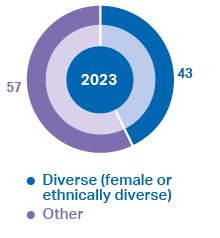
Sappi operates globally and across a variety of markets, jurisdictions and cultures, requiring a diverse mix of experience, skills, gender, age, culture and backgrounds. It is important that our board composition reflects this diversity, both in a South African context as well as globally. Diversity gives Sappi access to an increased range of talent, which helps to provide insight into the needs and motivations of a broader stakeholder base.
* Copyright and trademarks are owned by the Institute of Directors in South Africa NPC and all of its rights are reserved.
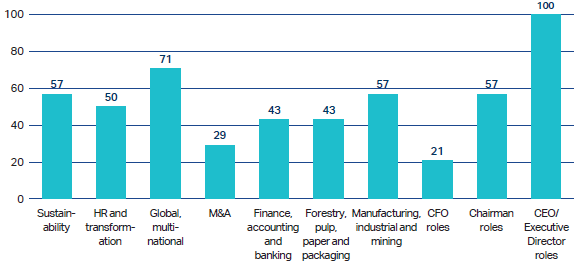
Board experience (%)
Sappi's board members have experience across multiple industries and leadership roles
The composition of the board and attendance at board meetings and board committee meetings is set out in the table below for the period 01 October 2022 to year ended September 2023:
| Board | Board committees | AGM | ||||||||||||||
| Name | Audit and Risk | Nomination and Governance | Human
Resources and Compensation |
SETS* | % attendance during tenure | |||||||||||
| Independent Non-executive Directors | ||||||||||||||||
| BR Beamish |  |
 |
 |
|
 |
|||||||||||
| MA Fallon | |
 |
 |
|
|
|
||||||||||
| JM Lopez | |
|
|
|
||||||||||||
| NP Mageza | |
|
 |
|
|
|
||||||||||
| ZN Malinga | |
|
|
|
||||||||||||
| B Mehlomakulu | |
|
|
|
|
|||||||||||
| MV Moosa |  |
|
|
|
|
|
|
|||||||||
| RJAM Renders | |
|
|
|
|
|||||||||||
| Sir Nigel Rudd |  |
|
 |
|
|
|
|
 |
|
|
|
|
||||
| LL von Zeuner | |
|
|
|
||||||||||||
| NL Sowazi |  |
|
 |
 |
|
|
||||||||||
| E Istavridis | |
|
|
|
|
|
||||||||||
| Executive Directos | ||||||||||||||||
| SR Binnie (CEO) | |
 |
|
|
|
|
|
|
|
|
||||||
| GT Pearce (CFO) | |
|
|
|
|
|||||||||||
Lead director Committee member (present)Chairman
 Ex officio
 Absent
 By invitationAppointed 01/10/2022
* Due to unforeseen circumstances, one of the SETS meetings was rescheduled just after the financial year-end. Included here for completeness of reporting for the 2023 financial year.
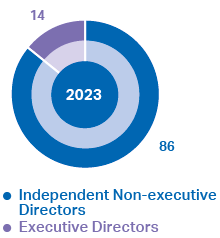
Directors' independence (%)
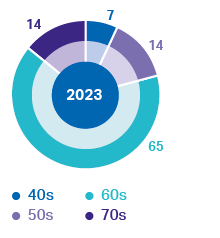
Directors' ages (%)
(average 62 years old)
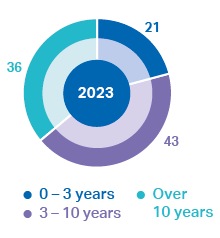
Directors' tenure (%)
as at year-end) (average 8 years)
Diversity (%)
In addition to the standard items on the board's agenda, the 2023 focus areas included:
All the top risks as well as emerging risks have been focused on by the board during 2023.
The following areas will receive specific focus by the board in 2024:
The board is responsible for presenting a balanced and understandable assessment of the group's position in reporting to stakeholders. The group's reporting addresses material matters of significant interest and is based on principles of openness and substance over form. The reporting includes information on key trade-offs that have to be made. Various policies have been developed to guide engagement with Sappi's stakeholders such as the group stakeholder engagement policy and group corporate citizenship policy on www.sappi.com/policies. Sappi has a policy addressing alternate dispute resolution (ADR) and relevant ADR clauses are generally included in contracts with customers and suppliers. There have been no requests for information for the period under review in terms of the Promotion of Access to Information Act (South African legislation).
Refer to Our key relationships for more information.
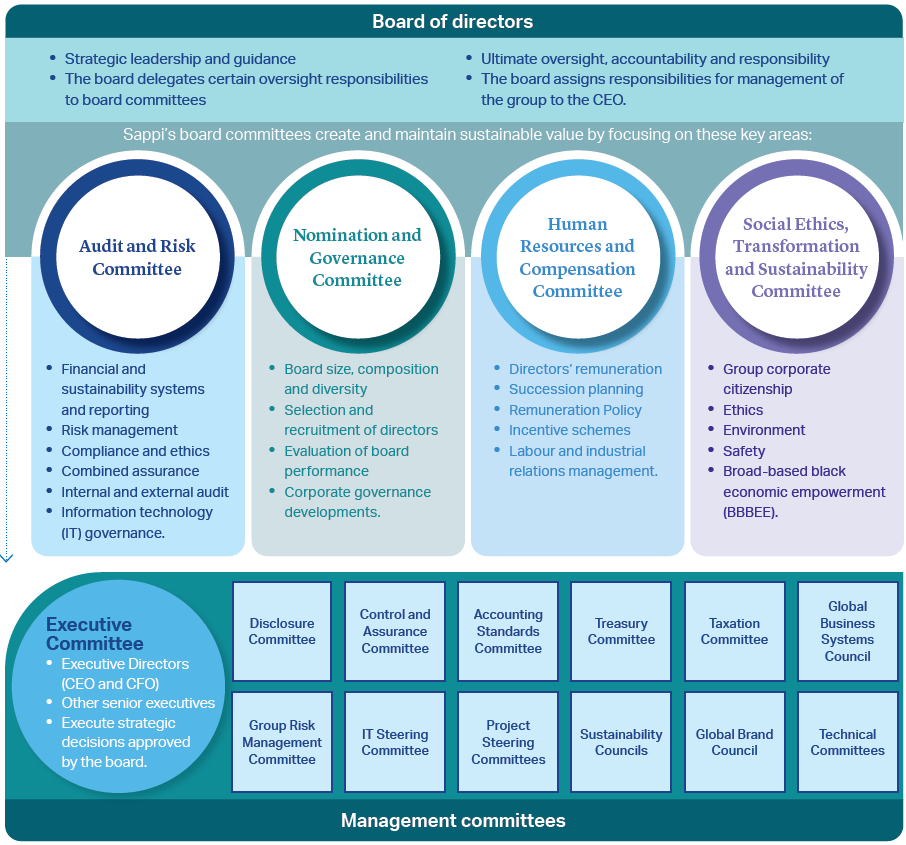
Board and management committees have been established and are discussed below.

The board has established committees to assist it to discharge its duties. The committees operate within written terms of reference set by the board.
Peter Mageza (Chairman)

97%
overall committee attendance rate
Stakeholders
The ARC has helped to create and protect value for the following stakeholders: employees, customers, shareholders and regulators.
Refer to Our key relationships for further details.
Risks
The ARC has focused on all of the top 10 risks:
For further details refer to Risk management.
The Audit and Risk Committee (ARC) consists of seven Independent NEDs. The committee assists the board in discharging its duties with oversight of:
The ARC helped to create and protect value by providing oversight and guidance for a wide range of topics, including the following areas related to Sappi's strategy:
Areas of oversight for the committee in 2024 will be:



For more information refer to the Audit and Risk Committee Report in our 2023 Group Annual Financial Statements.
The ARC confirms that it has received and considered sufficient and relevant information to fulfil its duties, as set out in the Audit and Risk Committee Report.
The external and internal auditors attended ARC meetings and had unrestricted access to the committee and Chairman. The external and internal auditors met privately with the ARC during 2023.
Mr Peter Mageza is the Chairman and designated financial expert of the ARC. Mr Mageza is due to retire from the board and the ARC in February 2024, and will be replaced, subject to approval by shareholders, at the AGM, as Chairperson and designated financial expert, by Ms ZN Malinga.
Mr Nkululeko Sowazi is due to resign from the ARC in February 2024 as he will take up the position as Chairman of Sappi Limited.
These changes to the membership of the ARC will reduce the membership to five members, which is aligned with the terms of reference of the committee.
The committee is satisfied that it has fulfilled its responsibilities as set out in its terms of reference.

Sir Nigel Rudd (Chairman)
100%
overall committee attendance rate
Stakeholders
The Nomination and Governance Committee has helped to protect value primarily for the following stakeholders: shareholders and regulators.
Refer to Our key relationships for further details.
Risks
The Nomination and Governance Committee focused on governance, independence, and composition of the board, board committees and executive management positions to effectively address all material risks facing the company including all the top 10 risks.
For further details refer to Risk management.
The Nomination and Governance Committee consists of three independent directors. The committee considers the leadership and governance requirements of the company including a succession plan for the board. The committee identifies and nominates suitable candidates for appointment to the board in line with Sappi's policy on the promotion of gender and race diversity at board level, for board and shareholders' approval. The committee considers the independence of candidates as well as directors. The committee makes recommendations on corporate governance practices and disclosures, and reviews compliance with corporate governance requirements. The committee has oversight of appraising the performance of the board and all the board committees. The results of this process and recommended improvements are communicated to the chairman of each committee and the board. The committee had oversight of the actions to implement the policy on broader diversity at board level. The functioning and performance of Sappi's board and board committees were assessed internally in 2023 and established that the board and board committees functioned well. Review of the type of training provided to directors, including the online training made available during 2023.
The Nomination and Governance Committee helped to protect value by providing oversight and guidance in 2023 over:
A focus area for 2024 will be onboarding directors appointed to new board and sub-committee roles and a handover process from the outgoing Chairman Sir Nigel Rudd to the new Chairman, Mr Nkululeko Sowazi.
The committee is satisfied that it has fulfilled its responsibilities as set out in its terms of reference.

Mike Fallon (Chairman)
95%
overall committee attendance rate
Stakeholders
The Human Resources and Compensation Committee has helped to protect value primarily for the following stakeholders: employees, shareholders and regulators.
Refer to Our key relationships and to the Remuneration Report for further details.
Residual risk ranking
The Human Resources and Compensation Committee has focused on the following of the top 10 risks:
For further details refer to Risk management.
The Human Resources and Compensation Committee consists of five independent directors.
The Human Resources and Compensation Committee ensures that the policy governing compensation practices and structures within the group support the group's strategy and performance goals. The policy also enables the attraction, retention and motivation of executives and all employees.
The committee ensures that the compensation philosophy and practices of the group, including the CEO's performance objectives, are aligned to the group's Thrive strategy and performance goals. It reviews and agrees the various compensation programmes and in particular the compensation of Executive Directors and senior executives as well as employee benefits. It also reviews and agrees to executive proposals on the compensation of NEDs for approval by the board and ultimately by shareholders. The committee is updated on the Industrial Relations Climate Training initiatives and engagement survey results and action items.
The 2022 report was supported at the annual general meeting (AGM) on the 8th of February 2023 with a vote of 94.86% on the Remuneration Policy and 84.80% on the implementation report. This has been a significant endorsement by the shareholders in relation to our ongoing commitment to good governance and disclosure.
Apart from its normal annual workplan, the key focus for the committee was on the following:
The strategic focus areas for the committee in 2024:


The committee is satisfied that it has fulfilled its responsibilities as set out in its terms of reference.
For more information refer to the Remuneration Report.

Valli Moosa (Chairman)
100%
overall committee attendance rate
Stakeholders
The SETS Committee has a broad spread of stakeholders for which it helps to protect (or create) value: suppliers, customers, employees, regulators, shareholders and society.
Refer to Our key relationships for further details.
Residual risk ranking
The Human Resources and Compensation Committee has focused on the following of the top 10 risks:
For further details refer to Risk management.
The Social, Ethics, Transformation and Sustainability (SETS) Committee comprises four independent NEDs and the CEO. A 100% attendance record was achieved by board committee members for 2023. Other executive and group management committee members attend SETS Committee meetings by invitation. It should be noted that a number of other NEDs attend SETS Committee meetings ex officio. The Chairmen of the ARC and SETS Committee attend each other's committee meetings to avoid unnecessary repetition of discussions.
The committee's mandate is to oversee the group's sustainability strategies, activities addressing climate change, ethics management, good corporate citizenship, labour and employment practices, health and safety, as well as its contribution to social and economic development and, with regards to the group's South African subsidiaries, the strategic business priority of transformation. The committee monitors progress towards and ensures that appropriate programmes are implemented to achieve the company's sustainability targets. The committee regularly reviews targets to ensure that they are both relevant to our operating context and reflective of an appropriate level of ambition.
As ESG reporting and disclosures become increasingly important to stakeholders and aligning with our strategic imperative to enhance trust, the committee is mandated to oversee the company's public disclosures ensuring that reporting is aligned with appropriate global standards and compliant with regulatory requirements.
The SETS Committee is supported by the Global Sustainability Council as well as by Regional Sustainability Committees in dealing with day-to-day sustainability issues and helping to develop and entrench related initiatives in the business.
In 2023 the committee provided oversight of:
The committee is satisfied that it has fulfilled its responsibilities as set out in its terms of reference.
The committee will provide oversight of the following strategic business areas in 2024: 
For more information refer to the SETS Committee Report and to Our global sustainability goals.
The board assigns responsibility for the day-to-day management of the group to the CEO. To assist the CEO in discharging his duties, a number of management committees have been formed. Some of these committees also provide support for specific board committees. The management committees are a key component of Sappi's second line of defence and assurance. Refer to below for additional details of Sappi's approach to risk, controls and assurance.
This committee comprises Executive Directors and senior management from Sappi Limited as well as the CEOs of the three main regional business operations and the dissolving pulp (DP) business. The CEO has assigned responsibility to the Executive Committee for a number of functional areas relating to the management of the group, including the development of policies and alignment of initiatives regarding strategic, operational, financial, governance, sustainability, social and risk processes. The Executive Committee meets at least five times per annum. All key topics discussed at board level are subject to review and discussions by the Executive Committee.
The committee is known as the Group Risk Management Team (GRMT) and is mandated by the board to establish, coordinate and drive the risk management process throughout Sappi. It has established a risk management system to identify and manage significant risks. The GRMT reports regularly on risks to the ARC and the board. Risk management software is used to support and report upon the risk management process. During 2023 key initiatives included operationalisation of the group's risk appetite and tolerance framework, dashboard summarising group risks and trends. Group business continuity plan guidelines were drafted, reviewed and approved. In 2024 the GRMT will review policy, procedures and assurance, and provide oversight of business units updating of their business continuity plans to address business continuity risk.
The Sappi Group Sustainable Development Council leads on all sustainability related policies and practices and provides support to the SETS Committee. Members meet quarterly to report progress against sustainability goals and key initiatives, share best practices, and exchange information on emerging issues. Members review regional information for various disclosure mechanisms, including the CDP's Climate Change, Forests and Water Programmes and the annual Group Sustainability Report.
Key focus areas for 2023 included:

This council coordinates Sappi's brand communication programme, monitors brand performance and ensures effective brand management to enhance Sappi's reputation.

For key strategic projects, steering committees are established to oversee successful execution of the project.
The Technical Committees' focus is on global technical alignment, performance and efficiency measurement as well as new product development.
The Disclosure Committee comprises members of the Executive Committee and senior management from various disciplines. Its objective is to review and discuss financial and other information prepared for public release. It is the ultimate decision-making body, apart from the board, with regards to disclosure.
The IT Steering Committee, assisted operationally by the Group IT Council (GITCO), promotes IT governance throughout the group and is the highest authority responsible for this aspect of Sappi's business, apart from the board. The committee has a charter approved by the ARC and the board. An IT governance framework has been developed and IT feedback reports are presented to the ARC and the board. Sappi IT has implemented a standardised approach to IT risk management through a group-wide risk framework supported by the use of risk management software. The committee has helped to create value for shareholders in 2023 by its oversight of:
A significant part of the IT Steering Committee's responsibility is to monitor and direct Sappi's Information and Cyber Security activities. The ARC oversees these activities. Security matters are shared and discussed with the board at least quarterly. Sappi does have cyber risk insurance. Sappi's internal IT audit team undertakes reviews of information and cyber security.
Oversight by the committee will continue in 2024 for these IT initiatives, as well as:

The Treasury Committee meets monthly to assess financial risks on treasury related matters. Specific focus areas in 2023 related to:
Key focus areas in 2024 will be:

The Sappi Accounting Standards Committee (SASC) meets regularly to discuss and decide on the accounting treatment and the application of accounting standards at Sappi. SASC comprises finance, treasury and accounting officers throughout the group. Internal and external audit attend meetings by invitation. A main topic of discussion in FY2023 was the discount rate calculation methodology used in the plantation valuation.
The Taxation Committee meets monthly to discuss and address global taxation matters. The main focus areas of the committee for 2023 included:
These topics will continue to receive oversight from the committee in 2024.
The Control and Assurance Committee (CAC) comprises group and regional heads of department representing all the main operating and support functions at Sappi. The CAC is supported by the internal control function and internal audit. A multi-disciplinary Combined Assurance Workgroup (CAW) provides oversight and guidance to the business on internal controls and combined assurance for financial, strategic and operational risks. The CAW provides input to the CAC, which in turn, is accountable to the GRMT and the ARC.
Sappi is committed to doing business the right way. Trust is created by operating from a commonly accepted set of values, enhancing and protecting our reputation. We require our directors and employees to act with integrity, to be courageous, to make smart decisions and to execute with speed, in all transactions and in their dealings with all business partners and stakeholders.
Our values underpin the group's Code of Ethics and commit the group and its employees to sound business practices and compliance with applicable legislation, which help to promote legitimacy.
All new employees receive training on the Code of Ethics and related topics, such anti-bribery and corruption and anti-competitive practices, as part of onboarding. The code was refreshed during 2022 and released in 2023. All employees receive refresher training on these courses every three years.
A group Supplier Code of Conduct (Code) has been developed and communicated to help ensure that Sappi's values and ethical standards are clearly understood and supported by all our suppliers, their first-tier suppliers and other stakeholders.
Actions are taken against employees and suppliers who do not abide by the spirit and provisions of our code. This includes termination of contractual arrangements, and criminal actions.
Refer to www.sappi.com for the Code of Ethics.
The programme is designed to increase awareness of, and enhance compliance with, applicable legislation in place. The group compliance officer reports twice per annum to the ARC.
Sappi's legal compliance programme has been boosted by:
Key focus areas in 2024 will be:
The use of software tools and the related training and online learning is helping to create and protect value primarily for employees, customers, shareholders and regulators.

The group has a policy that obliges all employees to disclose any interest in contracts or business dealings with Sappi to assess any possible conflict of interest. The policy also dictates that directors and senior officers of the group must disclose any interest in contracts as well as other appointments to assess any conflict of interest that may affect their fiduciary duties. Sappi undertook a conflict of interest policy relaunch with refresher training in FY2023.
During the year under review, apart from that disclosed in the financial statements, none of the directors had a significant interest in any material contract or arrangement entered into by the company or its subsidiaries.
For more information on how Sappi addresses conflict of interest please refer to the Preventing fraud and corruption section of the Code of Ethics at www.sappi.com
The company has a code of conduct for dealing in company securities and follows the JSE Limited Listings Requirements in this regard.
For further information refer to the Insider trading section of the Code of Ethics which can be found at www.sappi.com
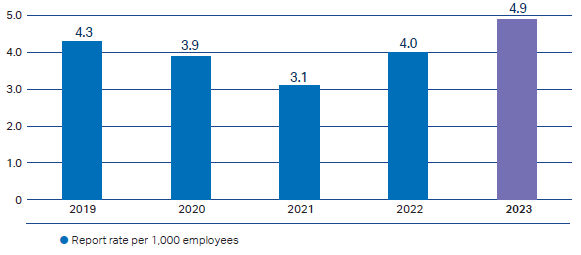
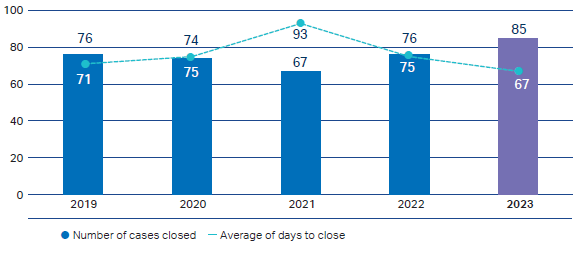
Sappi employees and stakeholders can report any potential illegal or non-compliant behaviour they observe directly to senior management, internal audit or legal counsel, or alternatively, report anonymously, via telephone or by completing an online web-portal form. Whistle-blower 'hotlines' have been implemented in all the regions in which the group operates. The hotline and web-portal service, operated by independent service providers, enables all stakeholders to anonymously report environmental, safety, ethics, accounting, auditing, control issues or other concerns. Retaliation against whistle-blowers is not tolerated. The follow up on all reported matters is coordinated either by legal counsel or internal audit and reported to the ARC. The majority of calls and ethics reports received related to the Southern African region.
Please refer to the whistle-blower hotline and ethics report graphs for information on the:
The hotline report rates categories of reports and outcomes of cases broadly align with international whistle-blower benchmark data. For more information, refer to the Reporting and whistle-blowing section of the Code of Ethics, at www.sappi.com
The group's results are reviewed prior to submission to the board, as follows:
Hotline report rate per 1,000 employees per annum
Forensic cases closed and average time taken to close
Hotline and ethics cases by category (%)
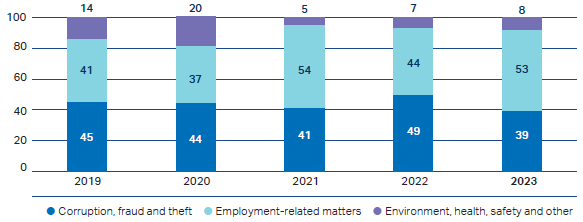
Hotline and ethics case outcomes (%)

Risks facing the group are identified, evaluated and managed by implementing risk mitigations, such as insurance, strategic actions or specific internal controls. Sappi maintains a robust framework of risks and controls which assists in the application of the King IV guidelines and the achievement of governance outcomes by helping to: create an ethical culture; establishing effective control; and promoting legitimacy, all of which help Sappi and its stakeholders to benefit from good performance. The framework includes controls addressing our material matters, by focusing on the main drivers of Sappi and comprises both financial and non-financial controls, which support the achievement of our strategy, within our risk appetite and tolerance levels, across the economic, social and environmental context in which the organisation operates as well as each of the six capitals set out in the IIRC's model. More information on these capitals and Integrated thinking in the context of Sappi's sustainable business model can be found in Our business model, as well as Risk management.
The group's internal controls and systems are designed in accordance with the COSO control framework to support the achievement of the group's objectives including strategic, operational and financial performance goals, effective and efficient use of resources, safeguarding assets against material loss, integrity and reliability of internal and external financial and non-financial reporting, and compliance with applicable laws and regulations.
Sappi operates a combined assurance framework, which aims to optimise the assurance coverage obtained from management, internal and external assurance providers, on the risk areas affecting the group. Combined assurance is overseen by the CAC. The committee and its CAW provide holistic feedback to the GRMT and ARC on the state of controls and the quality and coverage of assurance from the various assurance providers across Sappi's three lines of assurance. The workgroup focused on the following risk topics in 2023: fraud and ethics management, cyber security, operational technology, legal compliance, business continuity, taxation, contractors and maintenance, energy, waste and safety.
In FY2024 CAW will assist CAC to create and protect value by further developing combined assurance, risks and controls relating to IT security, continuity, regulatory compliance and sustainability.
Sappi's combined assurance framework, incorporating three lines of assurance and oversight by the board and board sub-committees
| First line of assurance |
Second line of assurance |
Third line of assurance |
Oversight by the board |
||||
| Risk areas and value drivers, capitals | Business management operations supported by appropriate controls and systems | Monitoring and oversight functions | Independent assurance provided by external audit, internal audit and other assurance providers | Board and board sub-committees | |||
| Governance, risk and controls – general (core business cycles) |
|
CAC, management self- assessments | Internal audit | Audit and Risk sub-committee | |||
| Strategy and vision, competition and markets, sociopolitical | Executive Committee, Group Head Strategy, Global Business Council, CAC, management self-assessments | Internal audit | Nomination and Governance Committee | ||||
| Financial, tax and treasury | Control and assurance, accounting standards, taxation, treasury and Disclosure Committees, management self-assessments |
KPMG, tax authorities, internal audit | Audit and Risk Committee | ||||
| Legal and compliance | Legal compliance programme, Group Compliance Manager | Legal compliance audits, internal audit | Audit and Risk, SETS Committee, Human Resources and Compensation Committees | ||||
| IT | IT Steering Committee, group IT governance functions, management self-assessments | KPMG, ISA 3402s, penetration testing, internal audit |
Audit and Risk Committee | ||||
| Planet, environment, natural capital | Sustainability councils, Environmental and Energy (E4) Global Cluster, GRMT | ISO 14001, FSC, PEFC, SFI, EMAS, KPMG, EcoVadis Government reviews emissions effluent etc, internal audit |
SETS Committee | ||||
| Ethics | Group Compliance Manager, ethics surveys, management self-assessments | Internal audit | SETS Committee, Audit and Risk Committee | ||||
| People, HR and transformation | Global Human Resource Committee, regional labour forums, employee engagement surveys, management self-assessments |
BBBEE audits, internal audit | Audit and Risk, SETS Committee, Human Resources and Compensation Committees | ||||
| Research and development (R&D), intellectual property | Group technical cluster, management self-assessments | ISO 17025, internal audit | SETS Committee | ||||
| Manufacturing, supply chain management, quality, forestry | Technical clusters and platforms, regional safety, health, environment and quality audits, supplier audits, management self-assessments | ISO 9001, ISO 50001, FSC, PEFC, SFI, Matrix, internal audit |
SETS Committee | ||||
| Stakeholders, communication, reputation, society | Group corporate affairs, sustainability and investor relations functions | Internal audit | SETS Committee | ||||
| Safety | Group and regional risk management teams, safety audits | ISO 45001, ISO 22000 regulatory inspections, internal audit |
SETS Committee |
A key element of combined assurance at Sappi is derived from the annual control self-assessments completed by control owners, which helps to protect value for stakeholders by providing management and the board with assurance on the state of controls throughout the group. The remediation of control gaps identified through this process is monitored by management, relevant committees, auditors and the board.
The ARC advises the board on the state of risk management and controls, as well as assurance, in Sappi's operating environment. This information is used as the basis for the board's review, sign-off and reporting to stakeholders, via the Annual Integrated Report and Annual Financial Statements, on risk management and the effectiveness of internal controls and assurance within Sappi.
As part of combined assurance in respect of reported information, Sappi has obtained assurance on the data in the Annual Integrated Report from the following sources:
The group has an effective, suitably resourced, risk-based internal audit department. The department operates in terms of a specific charter from the ARC and independently appraises the adequacy and effectiveness of the group's governance, risk management, systems, internal controls and accounting records. Internal audit coordinates combined assurance and reports the findings to local and divisional management, the external auditors, and the ARC.
The head of internal audit reports to the ARC, meets with board members, has direct access to executive management and is invited to attend certain management meetings. The role of internal audit at Sappi is set out in the following diagram:
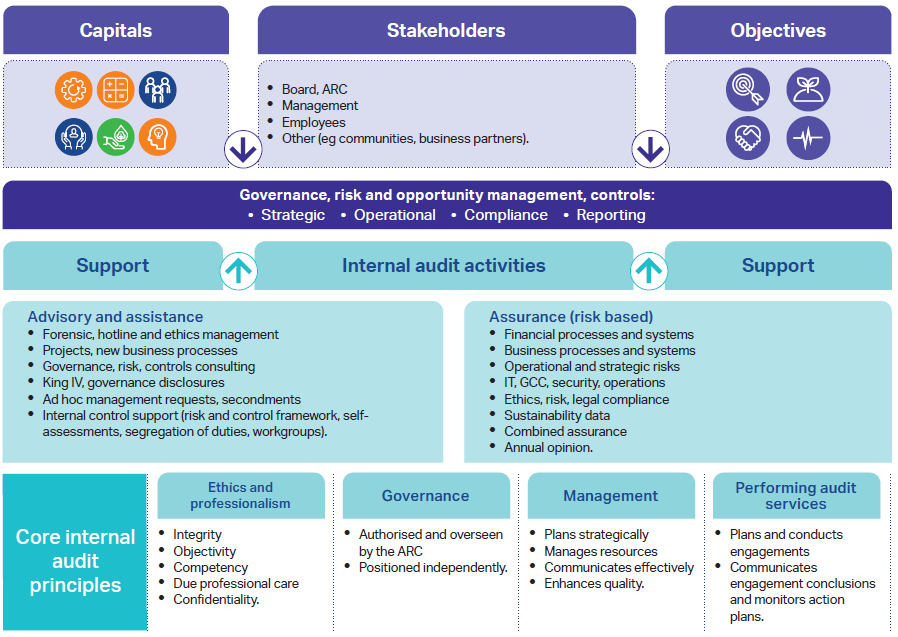
During 2023, the risk-based coverage plan was substantially achieved. Apart from the ongoing focus on financial controls, internal audit helped to create and protect value for Sappi and our stakeholders by completing reviews in support of the following strategic objectives:
In 2024 internal audit will support the achievement of Sappi's Thrive strategic objectives by completing advisory and assurance projects in the following areas:
 |
Grow our business: R&D, packaging and speciality papers, capital projects (Project Elevate in Sappi North America), and new businesses eg biomaterials |
 |
Sustain our financial health: sales, procurement, treasury, and working capital processes, mill closure activities |
 |
Drive operational excellence: sales and operations, maintenance, energy, strategic business and IT projects including global MES projects |
 |
Enhance trust: ethics, governance, sustainability, regulatory compliance and cyber security reviews |
Internal audit maintains an internal quality assurance programme. Our last external quality assurance review was conducted by the Institute of Internal Auditors (IIA) in 2021. A Generally Conforms rating was received, which is the highest of the three levels of conformance to the IIA's standards. The 2022 internal quality assurance review highlighted a need for upgrading our automated audit software solution. This was addressed in 2023. Our internal quality assurance review in 2023 confirmed our Generally Conforms rating. A focus area in 2024 will be adapting certain aspects of our procedures to comply with the Global Internal Audit Standards expected to be issued in 2024.
The board is responsible for the group's systems of internal financial and operational control. As part of an ongoing comprehensive evaluation process, control self-assessments, independent reviews by internal audit, external audit and other assurance providers, were undertaken across the group to test the effectiveness of various elements of the group's financial, disclosure and other internal controls as well as procedures and systems. Identified areas of improvement are being addressed to strengthen the group's controls further. The board has assessed the combined assurance provided in 2023. The results of the reviews did not indicate any material breakdown in the functioning of these controls, procedures and systems during the year. The internal controls in place, including the financial controls and financial control environment, are considered to be effective and provide a sound basis for the preparation of the Annual Financial Statements, Annual Integrated Report and other reports used internally for management decision-making.
The Company Secretary does not fulfil executive management functions outside of the duties of Company Secretary and is not a director. During the year, the board has assessed the independence, competence, qualifications and experience of the Company Secretary and has concluded that she is sufficiently independent (ie, maintained an arm's length relationship with the executive team, the board and individual directors), qualified, competent and experienced to hold this position. The Company Secretary is responsible for the duties set out in section 88 of the Companies Act 71 of 2008 (as amended) of South Africa. Specific responsibilities include providing guidance to directors on discharging their duties in the best interests of the group, informing directors of new laws affecting the group, as well as arranging for the induction of new directors.