 2020 Sappi Southern Africa Corporate Citizenship Report
What is this about?
Climate change is a real and undeniable threat to our entire civilisation. The effects are already visible and will be catastrophic unless we act now. Through education, innovation and adherence to our climate commitments, we can make the necessary changes to protect the planet. These changes also provide huge opportunities to modernise our infrastructure, which will create new jobs and promote greater prosperity across the globe.
 Why is this a priority goal and why does it matter?
For South Africa: As President Cyril Ramaphosa has said: “Climate change has a long been a measurable reality for South Africa. We have felt its effects in adverse weather conditions, droughts, flooding and rising temperatures. But climate change is about much more than changing weather patterns. It impacts water resources, food security, public health, public infrastructure, ecosystems and biodiversity. It affects the most vulnerable in society, who suffer the effects of extreme weather events and the degradation of ecosystems. Unless we act swiftly to significantly reduce carbon emissions and adapt to the effects of climate change, we will be facing one state of disaster after another for many years to come.” 7
For Sappi: As a responsible corporate citizen, we support the creation of a climate-resilient economy to protect jobs, ensure the sustainability of our industries, preserve our natural resources and ensure food security.
| 7 | President Cyril Ramaphosa, quoted in https://www.dailymaverick.co.za/article/2020-08-24-oureconomic- recovery-must-be-climate-resilient/ |
 What is Sappi doing about it?
In our mills
As this goal is strongly linked to SDG7: Affordable and clean energy, we are focusing on greater use of renewable energy. The activities described in the Renew section will help us in our goal of decreasing GHG emissions and the use of purchased fossil energy. Since 2014, we have reduced specific GHG emissions by 11.5%.
Vulindlela, our expansion project at Saiccor Mill, will result in fossil fuel CO2 emissions being halved and SO2 emissions being reduced by 37%. This is in addition to water use efficiency improving by 17% and waste to landfill reducing by a significant 48%.
In our plantations
Drought and pest infestations caused by climate change have already had an impact on plantation health. We continually monitor and review forest best practices in light of changing environmental factors, thus helping to mitigate any increased threat from water shortages or drought. To mitigate this threat, our tree breeding programme is producing and selecting the most optimally suited hybrid varieties for each climatic zone. Tree improvement is aimed at increasing pulp yield produced per hectare by testing various species and hybrids across Sappi’s diverse landholdings. As well as growth improvements, trees are bred for superior wood properties and resistance to biotic and abiotic threats including frost, drought, pests and diseases. A broad genetic base, acquired over 25 years, and a skilled breeding team exploiting new technologies are some of the assets of the programme.
| Decrease specific GHG (Scope 1 and 2) emissions | 20% |
| Decrease specific purchased fossil energy | 21% |
 |
How can I support this goal? |
Plant a tree – they help mitigate global warming by giving off oxygen and absorbing CO2
Maintain your car – a well-maintained car emits fewer toxic fumes
Drive less – walk, cycle, take public transport or car pool
Eat less meat – the production and distribution of meat has a huge impact on GHG
About GHG and Sappi
An over-concentration of the following six GHGs in the atmosphere can have a negative impact on the environment and on the health and welfare of current and future generations: CO2, hydrofluorocarbons (HFCs), methane (CH4), nitrous oxide (N2O), perfluorocarbons (PFCs) and sulphur hexafluoride (SF6).
The diagram below shows how we emit GHGs and how we mitigate these emissions.
 Scope 1
DIRECT EMISSIONS
Direct GHG emissions are the emissions we generate by burning coal, oil, gas and renewable fuels.
 CO2 emissions
CH4 emissions
 Scope 2
INDIRECT EMISSIONS
We generate indirect GHG emission from the combustion of purchased electricity (Eskom), together with heat and steam that we buy.
 Scope 3
PURCHASED GOODS AND SERVICE EMISSIONS
Scope 3 emissions are GHG emissions generated from the extraction and production of purchased materials and fuels; transport-related activities (employee commuting, business travel, and transport of goods); outsourced activities; use of sold products; end-of-life treatment of sold products; and waste.
 CO2 CAPTURE
CO2 is absorbed by the plantation trees which we use as a raw material, capturing carbon during photosynthesis. Most of the carbon remains sequestered in our products.
Carbon sequestration
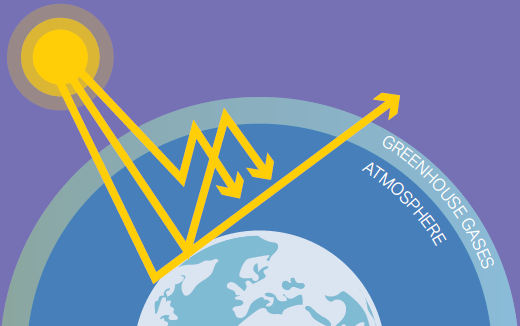
The greenhouse effect
Some sunlight that hits the earth is reflected, while some becomes heat. GHG like CO2 and other gases in the atmosphere trap heat, keeping the earth warm. The greenhouse effect makes earth a comfortable place to live. However, human activities are changing earth's natural greenhouse effect. Too many GHGs are causing earth's atmosphere to trap more and more heat, resulting in global warming.
|
How can I support this goal? |
Cover the pan with a lid. It reduces the amount of energy required to boil water by 75%
Use energy efficient lightbulbs and set your household appliances on low-energy settings
Turn lights off in rooms that aren’t being used. When you switch your lights off, even for a few seconds, it saves more energy than it takes for the light to start up, regardless of the bulb type