 2020 Sappi Southern Africa Corporate Citizenship Report
What is this about?
Renewable energy solutions are becoming cheaper, more reliable and more efficient every day. The world’s current reliance on fossil fuels is unsustainable and harmful to the planet, which is why we have to change the way we produce and consume energy. Implementing these new energy solutions as fast as possible is essential to mitigate climate change, one of the biggest threats to our own survival.
 Why is this a priority goal and why does it matter?
For South Africa: Our economy is heavily dependent on fossil fuel, particularly coal. This places our country among the world’s top 20 emitters of greenhouse gas (GHG) emissions, which play a significant role in global warming and climate change. The South African government has acknowledged the importance of diversifying the country’s energy base to include a greater proportion of renewable energy to decarbonise our economy.
For Sappi: As part of an energy-intensive industry, we have a responsibility to increase our use of renewable energy from our current figure of 47.2% as a percentage of total energy use. As our customers are looking to reduce their own carbon footprints, decarbonising our operations opens up a strategic business opportunity in terms of enhancing our competitive advantage.
 What is Sappi doing about it?
Since 2014, we have reduced our use of specific fossil fuel energy by 9.3%. In 2020, across each region, including Sappi Southern Africa, we committed to setting science-based decarbonisation targets through the Science Based Targets initiative (SBTi), a collaboration between the CDP, the United Nations Global Compact (UNGC), World Resources Institute (WRI) and the World Wide Fund for Nature (WWF). Our five-year target for SSA is a 20% reduction from our FY19 baseline.
To achieve this, we established a roadmap which incorporates the following:
To accelerate progress, our roadmap will be adapted as new ideas are developed and new insights and technologies become available.
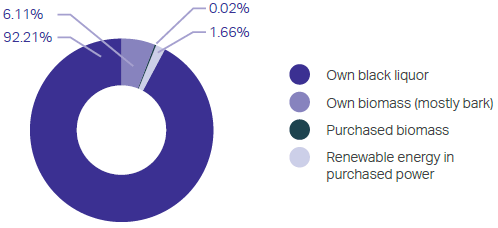
SSA renewable and clean energy breakdown (2020)
| Looking forward: Our Thrive25 target aligned with this SDG | ||
| Increase share of renewable and clean energy | 7% pts | |
| Decrease specific total energy | 9% |