Our business model
Select to view
- Inputs The resources and relationships on which we rely
- Our activities Our value streams
- Outputs Our products, services and waste products
- Outcomes The broader impacts of our business activities
- Actions to enhance outcomes
- Examples of our trade-offs The most difficult decisions made during the year


Capitals

Financial

Intellectual

Manufactured
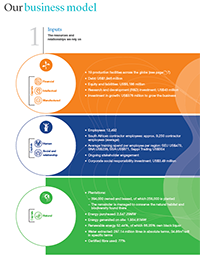
- 19 production facilities across the globe (see Where we operate)
- Technology centres in Europe, USA and South Africa
- Debt: US$1,163 million
- Equity and liabilities: US$6,229 million
- Research and development (R&D) investment: US$47.6 million
- Investment in growth: US$1,194 million.
SDGs: 
- Total assets: US$6,229 million
- EBITDA (excluding special items) US$1,339 million
- Net debt of US$1,163 million
- US$104 million paid to governments as taxation
- US$1,070 million paid to employees as salaries, wages and other benefits
- US$108 million paid to lenders as interest
- Resumption of dividend payments
- Our high levels of innovation give our customers a competitive edge in global markets
- New products developed to meet changing customer expectations and market trends
- Implemented a series of price increases in our paper businesses to offset rising input costs
- Ongoing diversification of our product portfolio into higher margin segments
- Commercialisation of biomaterials gaining traction
- Significant actions in all regions to resolve logistical issues
- Sale of three mills in Europe will help to reduce debt.
Although we have proven the technology to extract xylose sugars from our prehydrolysis kraft cooking processes, we have taken a step back as we identify potential market partners to develop commercial opportunities for bio-based products from this sustainable feedstock.
| Risk |  |
Supply chain disruption | ||
| Risk |  |
Cyclical macro-economic factors | ||
| Risk |  |
Liquidity |

Capitals

Human

Social and
relationship
- Employees: 12,495
- South African contractor employees: approx. 9,350 contractor employees (average)
- Weighted average training spend per employee: US$602.42
- Ongoing stakeholder engagement
- Corporate social responsibility investment: SEU €100,000, SNA US$417,000, SSA ZAR54 million.
SDGs: 
- Zero fatalities
- Global training average (weighted) of 46.89 hours per employee
- Productivity 3.8 hours worked per ton of saleable production (FY2021: 4 hours)
- Maintained our Level 1 BBBEE contributor status
- Globally, 74% of suppliers now in compliance with the Sappi Supplier Code of Conduct

- Continued investment in embedding a safety culture across the group
- Focus on entrenching transformation in our South African operations to support inclusive growth
- Investment in training and development of our employees, 65% allocated to skills training and 35% allocated to compliance training
- Strong governance and ethical culture reinforced by the Code of Ethics (refreshed shortly after year end)
- Social impact strategy in SSA gaining traction.
The sale of three mills in Europe could potentially impact employees.
| Risk |  |
Employee relations |

Capitals

Natural
- Plantations:
– 399,996 hectares (ha) owned and leased, of which 261,605 ha are planted
– the remainder is managed to conserve the natural habitat and biodiversity found there - Energy purchased: 2,661.7 MW
- Energy generated on site: 2,021.2 MW
- Renewable energy 53.9%, of which 66.5% own black liquor
- Water extracted: 300.82 million m3 in absolute terms, 34.4 m3/adt in specific terms
- Certified fibre used: 77%.
SDGs: 
- At stand level, our plantations have a negative impact on biodiversity. At plantation level, we manage this impact by managing approximately one-third of our landholdings for biodiversity
- Lighter weight packaging products – lighter carbon footprint
- High levels of water withdrawal
- 77% certified fibre supplied to mills enhances competitive advantage
- Year-on-year decrease in specific Scope 1 and 2 emissions of 4.8%
- Progressed our science-based targets which have now been validated by the Science Based Targets Initiative (SBTi)
- Finalised our climate change strategy
- Continued to shape our response to the impact of climate change on our plantations.
The implementation of our science-based targets will require significant capital investment of approximately US$70 million per annum.
| Risk |  |
Sustainability expectations | ||
| Risk |  |
Climate change | ||
| Risk | |
Liquidity |
 Forests
 Manufacturing excellence
 Biomaterials
 Pulp
Pulp Packaging and speciality papers
 Graphic papers
Products:
- 6,657,941 tons of saleable production.
Waste:
- 1,494,161 tons of waste generated, of which 1,146,618 tons (76.74%) diverted from disposal.
Emissions:
- 4.1 million tCO2e absolute direct (Scope 1) GHG, in specific terms: 0.61 tCO2e/adt.