
Sappi and the SDGs

“In fulfilling our commitment to the UN SDGs, we promote enterprise value while striving to make a positive impact on people and the planet.”
– Tracy Wessels
Sappi Limited Group Head Investor Relations and Sustainability
Q&A WITH DR TRACY WESSELS, GROUP HEAD INVESTOR RELATIONS AND SUSTAINABILITY
Dr Tracy Wessels previously headed up the Centre of Excellence for DP at Saiccor Mill for several years and is now Group Head Investor Relations and Sustainability.
You have been in your current role for nearly two years now. Are the SDGs gaining traction within Sappi?
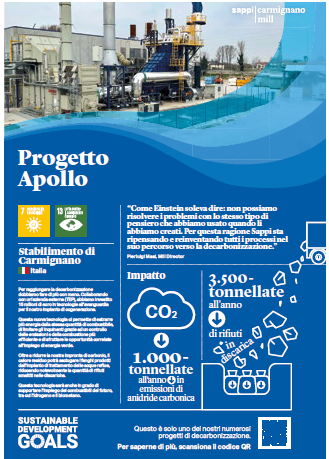
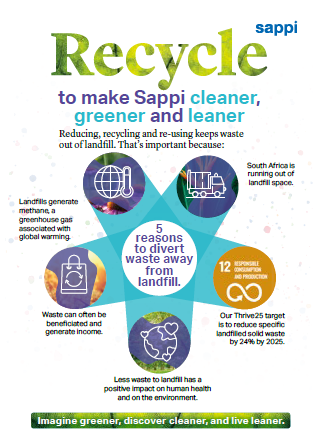
Yes, they are. People are increasingly referring to our performance against our priority SDGs in both informal and formal meetings and discussions – not just at senior levels, but also at lower levels of the organisation. This is being driven partly by focused internal communication campaigns. SEU is highlighting awareness of the SDGS with a series of eye-catching posters communicating relevant mill specific initiatives. SNA’s Ideas that Matter initiative now incorporates the SDGs (see Our key material issues of this report for further details). SSA is also driving awareness of the SDGs by structuring its annual corporate citizenship report around the SDGS, posters linked to the SDGs and a swap shop initiative linked to SDG12: Responsible Consumption and Production.
How do you measure progress against your SDG commitments?
Globally and in each region, we have established targets aligned with our priority SDGs. Performance against these targets is tracked and presented at our quarterly Regional Sustainability Council and Group Sustainable Development Council meetings. Ultimately, they are also reviewed by the Social, Ethics, Transformation and Sustainability (SETS) Committee. Our progress is published in our annual Group Sustainability Report and on the website.

How does your SDG performance over the last year live up to the theme of this year’s report and what were the highlights of the past year?
We are very proud of the way in which our people have adapted and advanced, despite significant operating challenges. In line with ‘amplify’, the theme of this year’s report, I would say our actions have been bolder than ever before.
Given that safety is one of our core values and that we strive to inculcate a 24/7 safety mindset within Sappi, under SDG8: Decent Work and Economic Growth, I have to mention the group’s outstanding safety performance in FY2022.
Another example is our newly developed Sustainable Financing Framework under SDG17: Partnerships for the Goals which is linked to our international RCF of €515 million.
This, our first financing facility with sustainability-linked KPIs, matures in February 2027 and comprises a consortium of eight relationship banks. The newly adopted Sustainable Financing Framework will now guide any sustainability-linked characteristics of future financing solutions. The framework was verified by ISS ESG with a second-party opinion that defines material sustainability KPIs and provides a basis for future KPI-linked credit and capital market activities for Sappi group.
These KPIs include:
- Decreasing specific GHG (Scope 1 and 2) emissions by 18% in 2025
- Ensuring certified fibre supplied to Sappi mills is in excess of 75% every year
- Reducing solid waste to landfill waste disposal by 15%
- Securing zero workplace injuries LTIFR for own employees.
Another significant milestone was the validation by the SBTi of our 2030 decarbonisation targets (SDG7: Renewable and Clean Energy and SDG13: Climate Action (refer to Q&A with the CEO)). We began the process in 2020 by committing to science-based targets but through an intensive collaboration process with the SBTi, we revised our targets to be more ambitious and have included a supplier engagement goal to include a Scope 3 component.
Since the Scope 3 target approved by the SBTi relates to our suppliers, it is also driving progress towards SDG17. Our suppliers play an essential role in our business, providing us with woodfibre and other materials and services with an indirect emissions impact.
Recognising that the more suppliers we can inspire to decarbonise their operations in the value chain, the faster the world can mitigate the effects of climate change. We are engaging vigorously with them to establish science-based targets of their own, striving towards our target that 44% o our suppliers by spend should have science-based targets by 2026.
In addition, our transparent reporting of our emissions can better enable our customers to reduce their own Scope 3 emissions and fulfil other climate-related commitments.
How has a challenging operating environment impacted Sappi’s progress towards the SDGs?
In addition to energy, the Russia-Ukraine war has had a knock-on effect on food security and prices. With people all over the world having to spend more of their income on food, progress towards SDG1: No Poverty, is lagging. World Bank estimates warn that for each one percentage point increase in food prices, 10 million people are thrown into extreme poverty worldwide1. SDG1 is one of SSA’s priority SDGs. Given that we are headquartered in South Africa and within the context of high levels of unemployment and poverty in the country, we have a particular responsibility to drive progress towards this goal.
We are doing so through a concerted focus on ESD, aimed at creating shared value and promoting systemic change (refer to Our key relationships). Our most significant ESD initiative through which we strengthen participation in the forestry value chain is Sappi Khulisa. This encompasses individual and community tree farming. The total area managed currently is 37,028 hectares. In 2022, under this programme, 217,339 tons of timber worth some ZAR184 million was delivered to our operations. Since 1995, a total volume of 4,908.850 tons to the value of ZAR3.03 billion has been purchased from Khulisa growers. Currently, the value chain extends from 4,143 growers to approximately 871 small, medium and micro enterprises who are involved in silviculture, harvesting, loading and short and long-haul activities.
Sappi partners with community managed projects through Forestry Enterprise Development agreements, to ensure continuous productivity of timber farms and sustainable supply of timber from land reform beneficiaries. In 2022, new areas under timber production expanded by 2,874 hectares on both Forestry Enterprise Development and Khulisa agreements.
Initiatives in South Africa aimed at enhancing food security and generating income include an aquaponics project at Ngodwana Mill, beekeeping on our land, a peanut farming venture started by a group of women on our land and a pilot avocado farming project. These initiatives are described in more detail in Our key relationships and in our Group Sustainability Report, available at https://www.sappi.com/sustainability-and-impact
We also remunerate, at least in accordance with the minimum wage in South Africa, just over 9,300 contractor employees.
| 1 | https://www.worldbank.org/en/news/statement/2022/04/13/joint-statement-the-heads-of-the-world-bank-group-imf-wfp-and-wto-call-for-urgent-coordinated-action-on-food-security |
As Sappi’s business is based on woodfibre, SDG15: Life on Land is extremely important. Would you say it’s the most important SDG for Sappi?
I don’t think one can isolate one SDG as being more important than another. It depends on context, which is why we have prioritised the SDGs most relevant to Sappi. What is apparent is that the SDGs are all interlinked. Sappi’s business is based on woodfibre sourced from healthy forests and plantations. When sustainably managed as these are, they provide robust ecosystem services which contribute towards SDG1: No Poverty, SDG8: Decent Work and Economic Growth and SDG13: Climate Action.
In a few months’ time, the global spotlight will be even more intensively on SDG7: Renewable and Clean Energy and SDG13: Climate Action at COP27. How achievable is a lower-carbon global economy?
Global decarbonisation plans have been hampered by the Russia-Ukraine conflict, which has caused energy prices to spike as described in the operating context section. Nevertheless, while there might be setbacks in the short term, the world cannot afford to relax efforts in the medium term.
Financing will play a key role in helping to drive decarbonisation. At COP27, the developed nations of the world need to progress initiatives like the Just Energy Transition Partnership announced at COP26, in which five developed countries (France, Germany, the UK, the US and the EU) agreed to channel US$8.5 billon to support a just, equitable transition in South Africa. The initiative focuses on increasing renewable energy capacity and a faster exit from coal, while spurring innovation in electric vehicles and green hydrogen. Similarly, in the US, the landmark IRA includes US$369 billion in climate and energy related funding and incentives to ramp up carbon-capture facilities, drive green hydrogen production and boost US manufacturing of solar panels, wind turbines and next-generation batteries.
Shortly after our year end, the South African Presidency released a ZAR1.5 trillion investment plan for the next five years to assist the country's Just Transition to a greener economy. The bulk of the funding will go towards the electricity sector, which is the biggest contributor to GHG emissions in the country. More than 80% of Eskom’s electricity is generated by coal and over the last three years, on average, approximately 35% of SSA’s power was sourced from Eskom.
It's important that the transition is achieved in a just manner. The social implications of an exit from fossil fuels in countries like South Africa where unemployment is already at record highs are potentially catastrophic. Our hope is that significant progress will be made on developing concrete action plans and finance frameworks to deliver on the promise of a global just transition where no-one is left behind.
“Addressing climate change requires significant and unprecedented transformation across all sectors of the economy, with opportunities and challenges. Workers, communities, and poor people, whose lives and livelihoods are tied to high-emitting industries, may be particularly affected. It is for that reason that the Presidential Climate Change Commission developed the recommendations for the Just Transition in a manner that supports and empowers impacted groups.”
– Valli Moosa
Deputy Chairperson of South Africa’s Climate Change Commission and Chairman of Sappi’s SETS Committee