Governance
In order to unlock the power of renewable resources to benefit people, communities and the
planet, we need to do so from a foundation of trust. This foundation is reinforced by our
robust sustainability governance framework summarised below.
Sappi sustainability governance framework
| Sappi board |
|
| Committees |
| |
Other board committees |
|
|
|
|
|
|
Social, Ethics,
Transformation
and Sustainability
(SETS)
Committee |
Audit and
Risk |
Remuneration
and
Compensation |
|
Executive Committee |
|
Group
Sustainable
Development
Council (GSDC) |
|
Regional
Sustainability
Councils |
| Chaired by an Independent Non-executive Director |
Chaired by an Independent Non-executive Director |
Chaired by an Independent Non-executive Director |
|
Chaired by the group CEO |
|
Chaired by the Group Head: Sustainability and Investor Relations |
|
Chaired by regional CEOs and sustainability leads |
| Purpose |
| Oversees the group's sustainability strategy, commitments, policies and performance against targets |
Oversees the group's corporate financial reporting, internal control systems, risk management, and relationship with the external auditor |
Ensures that incentives drive the appropriate behaviours that deliver our strategy |
|
Management responsibility for execution of sustainability strategy and policies guided by the SETS Committee |
|
Provides expert insights and support to the business on sustainable development matters |
|
Oversees the integration of sustainable development into the operations |
| Responsibility |
| Responsible for the governance of matters related to sustainable development, including environment, climate change, biodiversity, product stewardship, labour, human rights, diversity, and transformation and ethics. Ensures alignment to best practice and disclosure standards |
Oversees the group's corporate financial reporting. Oversees the risk management process, including sustainability risks. Monitors effectiveness of internal control systems, including hotline reporting platform |
Aligns remuneration to performance against key sustainability targets and focus areas |
|
Prioritises capital allocation and ensures business unit line management holds primary responsibility and accountability for sustainability performance |
|
Keeps abreast of best practice and regulatory compliance requirements. Develops sustainability-related strategy and policies for the group |
|
Develops action plans aligned with strategy and policies and monitors progress towards sustainability targets and commitments. Ensures integration of sustainability requirements into operational systems and processes |

Oversight |
|
Accountable |
|
Advisory |
|
Execution |
At board level, the Social, Ethics, Transformation and
Sustainability (SETS) Committee plays an independent
oversight role. Comprised mainly of Independent Non-Executive Directors, it guides management and monitors
progress on key issues, including climate, nature, equity,
diversity, ethical conduct, and social impact. The SETS
Committee also reviews the group's sustainability strategies,
targets, and public disclosures to ensure transparency and
alignment with global best practice.
Supporting the board and SETS Committee, the Audit and
Risk Committee oversees sustainability-related risks within
the broader risk management and reporting processes and
the resolution of any unethical behaviours reported through
Sappi's confidential, independently operated hotline. The
Remuneration and Compensation Committee ensures
that incentive structures are tied to performance against
sustainability commitments. The Nomination and
Governance Committee is responsible for ensuring that
the board and executive management teams have the
appropriate skills to manage climate-related issues.
Operational accountability lies with the Sappi Executive
Committee, chaired by the group CEO, which integrates
sustainability into business strategy, capital allocation, and
performance delivery. Sappi Executive Committee reviews
progress against sustainability commitments and targets
regularly and ensures strategic alignment before matters
are escalated to the SETS Committee.
Specialist advisory bodies further strengthen governance.
The Group Sustainable Development Council (GSDC)
tracks global and regional trends, shaping strategy and
policy. Meanwhile, Regional Sustainability Councils in Europe,
North America, and South Africa translate global commitments
into local action plans, ensuring delivery on the ground.
Together, this multi-layered governance framework provides
robust oversight, drives accountability, and ensures that
Sappi's sustainability commitments are consistently
embedded in strategic decision-making and operational
practice.
Strategy
Sustainability lies at the core of Sappi's Thrive strategy,
shaping how we operate, innovate and grow, while ensuring
the responsible use of natural resources. Guided by our
4P framework (Principles, Prosperity, People and Planet)
and informed by double materiality assessments, we adopt
a holistic approach that recognises the interconnection
between climate, forests, water and biodiversity.
Our climate strategy supports the four pillars of Thrive (grow
our business, sustain our financial health, drive operational
excellence, and enhance trust) by linking climate action
to innovation, efficiency, financial resilience, and social
responsibility. We prioritise the development of low-carbon,
biobased products, continuous improvement of our energy
and resource efficiency, investment in renewable energy,
and strong partnerships that promote transparency and
a just transition.
Using climate scenario analysis and risk tools, we identify,
mitigate and adapt to climate-related risks, embedding
sustainability in strategic decision-making. Integrated across
governance, operations and long-term planning, this
approach underscores our commitment to a resilient and
inclusive transition to a low-carbon economy.
We have a validated 2030 (well-below-two-degree) science-based
Scope 1 and 2 decarbonisation target as a key
milestone in our transition. Our Scope 3 approach focuses
on engagement and collaboration across our value chain
to drive collective climate action. We use our influence
to encourage key suppliers to set science-based targets
(SBTs) and are actively working with them to collect primary
emission factors to improve the accuracy of our
Scope 3 inventory. While we have made progress,
we recognise that supplier maturity levels vary significantly,
and challenges remain in accurately disaggregating product-level
emissions. At this stage, we do not yet have sufficient
primary data to set a quantified Scope 3 reduction target.
However, we continue to build capacity, share best practices,
and collaborate through industry platforms and sector
associations to strengthen supplier engagement and
advance Scope 3 decarbonisation efforts over time.
Sappi fully supports the principles of the Paris Agreement
and aspires to achieve net-zero greenhouse gas emissions
by 2050. However, structural challenges in South Africa's
coal-dependent energy system currently prevent us from
setting a formal group-wide net-zero target. Our South
African operations, which account for the majority of our
Scope 2 emissions, remain reliant on Eskom's coal-based
grid. The recently approved IRP 20251 confirms that South
Africa does not yet have a credible, net-zero-aligned
decarbonisation pathway, with ongoing constraints
in transmission infrastructure, renewable capacity, and
policy reform.
Despite these challenges, Sappi continues to advance
decarbonisation through direct renewable investments,
efficiency improvements, and active participation in national
just transition initiatives such as the National Business
Initiative's Climate Pathways Study and the JET Skilling for
Employment Programme. We remain steadfast in our
commitment to reducing our Scope 1 emissions, advocating
for collaborative, equitable solutions for Scope 2 abatement,
and positioning Sappi as a resilient, low-carbon business
ready to thrive in a sustainable future.
1 https://www.dmre.gov.za/mining-minerals-energy-policy-development/integrated-resource-plan/irp-2025.
Sappi's key decarbonisation levers and transition pathway
In the short and medium term, Sappi's decarbonisation
strategy focuses on abatement investments to continuously
reduce emissions from high-emitting assets and reduce
energy intensity using best-available technology. In the
longer term, Sappi will evaluate emerging technologies and
collaborate with strategic partners to understand feasibility
and cost of new technologies that will reduce hard-to-abate
emissions.
Scope 1 and 2 emissions
1
Exiting fossil fuels
- Converting our boilers from coal/gas to biofuels
- Electrification.
2
Energy efficiency, process improvements and new technologies
- Investing in best-available and new technologies to reduce energy intensity of our operations.
3
Investments in on-site renewable energy
- Investing in new solar/wind/biomass energy assets (specific to South Africa).
4
Greening our electricity supply
- Procuring clean and renewable energy.
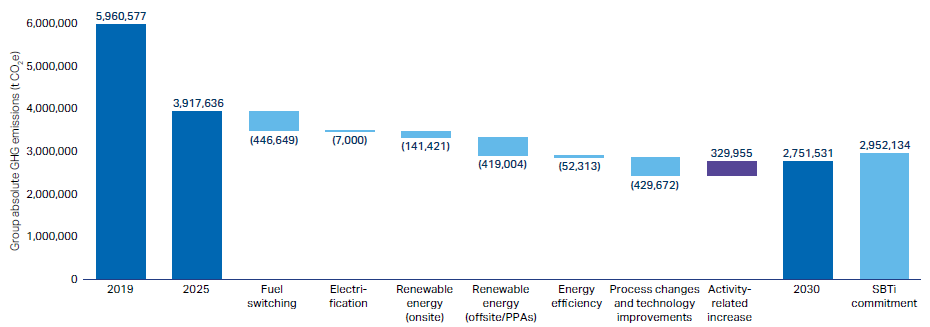
The graph below illustrates Sappi's current 2030 transition
pathway, showing achieved abatement from 2019 to 2025
and the potential contribution of decarbonisation levers
towards 2030. This pathway reflects the projects currently
identified within our plan, which is reviewed annually to
ensure alignment with business priorities and evolving
market conditions. All decarbonisation projects are evaluated
on their individual merits within regional contexts as well as at
a group level and are prioritised based on their return on
capital and CO2 abatement potential. We estimate the cost
of our transition at US$60 million to US$70 million per annum.
The plan remains dynamic and continues to evolve as
opportunities and technologies develop, while progress is
highly dependent on the availability of capital to support these
investments. Our short and medium-term focus is on direct
abatement of emissions from our operations and value chain.
As our 2030 climate transition plan continues to evolve, we
are also assessing our longer-term abatement opportunities
toward 2050, with a particular focus on identifying and
advancing Scope 1 emission reduction levers within our
South African operations. While we do not believe that a
net-zero commitment is appropriate at this stage, we remain
committed to progressively developing our transition plan
in line with emerging technologies, policy developments, and
sectoral progress. We recognise that as we approach 2050,
some residual emissions may remain unavoidable, and we will
evaluate credible neutralisation solutions to address these
in a responsible and transparent manner.
Sappi Group 2030 transition pathway
The role of forests in climate action
Trees and forests play an integral role in the global carbon
cycle. Through sequestering carbon dioxide from the
atmosphere and storing it in forest biomass and soils,
forests store vast amounts of carbon and release oxygen
back into the atmosphere. Recent studies point to the further
contribution that trees and forests could deliver to mitigate
climate change if afforestation, reforestation, and restoration
efforts were scaled up substantially. Managing forests for
wood production can help maximise their contribution
to carbon sequestration. Forest management practices,
which rely on scientific knowledge of silvicultural best
practices applicable in respective vegetation zones, promote
growth and carbon sequestration. In our plantations in South
Africa and in the managed forests from which we source
our wood raw material, the cycle of regeneration, growing,
thinning and harvesting is actively managed to enhance
biodiversity, resilience, and maintain functional ecological
condition. Deforestation negatively impacts ecosystem
services and climate. It also increases the transmission
risk of zoonotic diseases. In addition to helping to respond
to climate change and protect soils and water, forests
hold more than three-quarters of the world's terrestrial
biodiversity. This means that deforestation has serious
negative impacts on both biodiversity and climate change.
The pulp and paper industry provides dependable markets
for responsibly grown woodfibre, thereby incentivising
long-term sustainable forest management. This assurance
of financial returns enables and encourages landowners
to manage their forestlands as working forests, instead
of selling the land for development or converting it to
non-forest uses. Furthermore, the pulp and paper industry
typically utilises different species and/or smaller diameter
trees or portions of trees that are not desirable in the solid
wood industry. By providing this market and revenue stream,
the industry is supporting necessary holistic forest stand-improvement
activities that are essential for maintaining
and restoring forest health, species and age-class balance,
wildlife habitat and biodiversity, wildfire mitigation and
hazardous fuels reduction, watershed protection, soil
conservation, and carbon sequestration. By ensuring forests
and plantations are sustainably managed through high levels
of certification and prioritising traceability, we can help
combat climate change and enhance the ecosystems
services that contribute to greater levels of economic and
environmental wellbeing. Our opportunity is to invest in and
promote healthy forests both for our benefit and the benefits
they deliver to the planet.
Our commitment to deforestation free forestry operations
and supply chains through wood sourcing from sustainably
managed, healthy working forests with a high level of forestry
certification enable us to offer products to our customers
around the world that carry no risk of deforestation or forest
degradation.
Forestry emissions and removals
Climate impacts within our own plantations, our manufacturing
operations and our products are considered within our
transition plan by using a double materiality impact approach.
This holistic approach considers both the financial impact
and environmental and social impact of carbon emissions
and removals across our own operations and value chain,
with land-based (forest) emissions and removals being a key
component of our climate impact. Forests form an integral
component of Sappi's transition plan due to the critical role
they play in carbon sequestration, absorbing large amounts
of CO2 from the atmosphere and helping to mitigate climate
change. Sustainably managed forests ensure a renewable
supply of woodfibre for our operations while maintaining
biodiversity and ecosystem health, which are essential for
resilience against climate impacts. Additionally, by preventing
deforestation and promoting sustainable forest management
(SFM) practices, we can reduce emissions linked to land-use
changes, contributing to global climate goals.
We monitor and report greenhouse gas (GHG) emissions
and removals from our forestry operations in line with
evolving global standards. The Greenhouse Gas Protocol's
forthcoming Land Sector and Removals Guidance (LSRG)
is likely to become the standard framework. Sappi has been
actively engaged in shaping this guidance through technical
working groups and pilot testing. Nonetheless, stakeholder
misalignment has delayed finalisation of the LSRG. We
continue to proactively monitor these developments.
Sappi's forestry biogenic CO2 emissions/removals are
calculated using the stock-difference method1, which
measures annual changes in carbon stocks between
two inventory years across the more than 15,000 forest
compartments making up our plantation landholdings
in South Africa. Estimates are based on living biomass
(above and below ground) using primarily Tier 1 IPCC
methods, supplemented with country-specific biomass
expansion factors2. Field and LiDAR inventory data are
combined with empirical modelling to estimate growing
stock, while soil carbon, litter, and harvested wood products
are excluded in line with GHG Protocol Agricultural Guidance.
Our forestry emissions and removals are reported one year
in arrears due to the timing of data availability. Detailed
forestry activity data, including growth measurements,
harvesting records, and land-use changes, are only finalised
and verified early in the following financial year. This timing
ensures that reported figures are based on complete and
accurate datasets, maintaining the integrity and reliability
of Sappi's greenhouse gas inventory and sustainability
reporting. For FY2024, Sappi Forests reported
590,707 tons of net biogenic CO2 removals, despite
912,672 tons of gross biogenic CO2e emissions from
natural disturbances. Our plantations represent a CO2e
living biomass pool of 40.7 million tons.
Non-biogenic forestry (fossil-based) CO2e emissions are
calculated following GHG Protocol Agricultural Guidance,
covering all major forestry activities under a cradle-to-gate
boundary, including establishment, management, fire
prevention, harvesting, and transport. Emissions sources
include fuel combustion, grassland burning for biodiversity
and fire control, wildfires, burning of harvest residues, and
land-use change where plantation areas were restored
to natural habitats.
In 2020, the biogenic GHG pool became a net source
of emissions following extensive wildfire damage that
significantly reduced standing tree carbon stocks. Between
2022 and 2024, above-average rainfall drove exceptional
tree growth, leading to strong biogenic carbon removals
during this period. Over the past six years, these removals
have, on average, been sufficient to offset non-biogenic
emissions. Our overall objective, in line with sustainable
forestry management practices, is to maintain a balanced
carbon cycle in our plantations, where annual growth,
harvesting, and natural disturbances are in equilibrium, and
we achieve long-term net-zero biogenic emissions while
ensuring forest health and productivity. Through sustainable
forest management (SFM) and adherence to strict
certification and traceability standards, we ensure that
our woodfibre supply supports both climate action and
ecosystem resilience.
As methodologies such as the GHG Protocol Land Sector
and Removals Guidance and SBTi FLAG framework evolve,
we continue to participate in their development, reinforcing
our commitment to sustainable forestry as a cornerstone
of our climate strategy.
Aligning our external engagement activities
Sappi's approach to external engagement is grounded
in transparency, accountability, and alignment with global
climate goals. Guided by our Code of Ethics, Sustainability
Charter and commitments to the Paris Agreement and
UN SDGs, notably SDG 7: Clean energy and SDG 13: Climate
action. We engage with stakeholders through formal policy
consultations, industry associations, and multi-stakeholder
forums to advocate for effective, science-based climate
policy. Climate and nature-related issues are regularly
reviewed by senior leadership and regional sustainability
councils to ensure alignment with our global strategy.
Emissions (removals) (t CO2e)

Sappi forests' Scope 1 GHG emissions between 2019 and 2024, as well as the mean values over this period, are presented and separated into biogenic and non-biogenic GHG emissions. The total represents the sum of these two categories.
1 This approach follows Equation 2.5 from the IPCC 2006 Guidelines for National Greenhouse Gas Inventories (Volume 4, Chapter 2, p. 2.9).
2 Dovey, S., du Toit, B. and Crous, J., 2021. Tier 2 above-ground biomass expansion functions for South African plantation forests. Southern Forests: a Journal of Forest Science, 83(1): 69-78.
Climate-linked finance and remuneration
We embedded sustainability into our capital structure
through instruments such as our EUR515 million sustainability-linked
revolving credit facility and EUR300 million sustainability-linked
2032 bond, both tied to key performance indicators
on GHG emissions, certified fibre sourcing, and waste
reduction. These mechanisms reinforce accountability
and demonstrate how sustainability performance directly
influences financial outcomes. Given the strategic
importance of sustainability, leadership remuneration
is linked to their contribution to the overall success of our
Thrive strategy. Specifically, a portion of the personal
objectives within the short-term management incentive
scheme (MIS) is directly linked to climate change through
emission reduction, forestry certification and waste-to-landfill
performance targets. Additionally, from FY2024, 10%
of the long-term incentive (performance share plan – PSP)
is linked to performance against our validated well-below-two-degree science-based target. This integrated approach
ensures that climate action is embedded not only in strategy
and governance, but also in financial and leadership
accountability.
For further details on our remuneration policy, see our
Remuneration Report.
Climate scenario modelling
Sappi adopts an integrated, science-based approach
to climate scenario modelling to assess both physical and
transitional risks and embed the findings into our business
strategy, risk management, and action plans. Our modelling
helps us understand how different climate futures could
affect our operations, forests and value chain, thereby
enhancing our ability to anticipate, adapt, and build long-term
resilience. We have conducted physical risk modelling across
all of our manufacturing and forestry operations using
multiple climate scenarios (including RCP and SSP pathways),
evaluating indicators such as heat stress, drought, flooding,
and wildfire exposure. This has been supplemented with
locally downscaled forestry modelling in South Africa and
water risk scenario analysis to inform site-level adaptation
measures and capital investment priorities. In parallel,
we have conducted transition risk modelling in collaboration
with S&P Global, assessing how evolving policy, market,
and carbon pricing scenarios may affect our costs,
competitiveness, and value chain. The outcomes of these
analyses directly inform our climate transition plan, capital
allocation, and strategic resilience initiatives, ensuring climate
considerations are embedded into decision-making at
every level.
For more detail on our climate scenario modelling and
outcomes, please refer to our full TCFD Report.
Risks, opportunities and adaptation
Sappi has a comprehensive and integrated approach
to managing climate-related risks, opportunities, and
adaptation, fully embedded within our enterprise risk
management and governance framework. Climate change
is recognised as a principal strategic risk, and climate
considerations are incorporated into strategic planning,
financial decision-making, and capital allocation across our
operations. Our annual risk evaluation process identifies and
monitors both physical and transition risks, with site-level
assessments led by regional risk managers and supported
by environmental, regulatory, and R&D expertise. We have
identified five physical risks, mainly linked to our South
African plantations and woodfibre supply chains, and one
key transition risk associated with policy and market
shifts. Correspondingly, we see significant operational and
transitional opportunities in advancing low-carbon and
circular biobased solutions.
Sappi recognises that effective climate adaptation
is critical to ensuring business continuity, safeguarding
natural resources, and supporting community resilience.
Our adaptation strategy builds long-term resilience across
both manufacturing and forestry operations, guided by
detailed climate risk assessments and scenario analyses.
In manufacturing, adaptation actions focus on flood
protection, water-use efficiency supported by investment
in catchment management and contingency planning
to maintain operational continuity. In forestry, we focus
on climate-smart forestry management and tree breeding
programmes to improve resilience against drought, pests,
and disease, ensuring a sustainable fibre supply under future
climate conditions.
Our adaptation efforts also extend beyond our operations.
Through partnerships such as the WWF uMkhomazi
catchment water stewardship project, Sappi works
to enhance water security, ecosystem resilience, and
community wellbeing. We have established integrated
community forums around key South African sites
to strengthen local preparedness, facilitate stakeholder
collaboration, and prioritise climate adaptation initiatives.
Through this integrated approach, which links risk
management, adaptation, and innovation, we aim to
strengthen business resilience, protect the ecosystems
and communities that sustain our operations, and contribute
to a just and sustainable transition in every region where
we operate.
At the same time, we view climate action as an opportunity
for innovation and sustainable growth. By investing in
decarbonisation and resource efficiency, we are advancing
toward our 2030 science-based targets while positioning
for leadership in the circular bioeconomy. Our expanding
portfolio of sustainable packaging, speciality papers, and
dissolving wood pulp (DWP) enables our value chains to
transition from fossil-based to renewable products, supporting
a global shift toward low-carbon, circular solutions.
In terms of climate opportunities, Sappi is well-positioned to lead in the transition to a circular, biobased economy by replacing
fossil-based materials with sustainably sourced, fibre-based products. Our innovations in packaging papers, speciality papers
and dissolving wood pulp (DWP) enable our value chains to reduce their carbon footprint while capturing growing demand for
sustainable textiles such as lyocell, a leading next-generation cellulose fibre. Together, these efforts demonstrate Sappi's
commitment to managing climate risks proactively, while unlocking new opportunities for sustainable growth and resilience
in a changing global environment.
| |
|
|
|
| Physical risks |
| South African plantation losses due to drought |
|
Long term |
|
Medium |
|
5 to 25 |
|
Likely |
| South African plantation losses due to increased ecosystem vulnerability |
|
Medium to long term |
|
Medium |
|
5 to 25 |
|
Very likely |
| South African plantation losses due to wildfire |
|
Short to long term |
|
Medium-high |
|
20 to 180 |
|
Virtually certain |
| Wood supply chain disruptions in North America and Europe |
|
Medium to long term |
|
Medium |
|
10 to 25 |
|
Likely |
| Interruptions to South African mill operations and supply chains due to drought |
|
Medium to long term |
|
Medium |
|
10 to 50 |
|
More likely than not |
|
|
|
|
|
|
|
|
|
| Transitional risks |
| GHG regulatory changes and changing downstream requirements for low-carbon products |
|
Medium to long term |
|
Medium-high |
|
20 to 100 |
|
More likely than not |
|
|
|
|
|
|
|
|
|
| Operational opportunity |
| Reduced operating costs through energy efficiency and use of renewable energy |
|
Short to long term |
|
Medium |
|
20 to 50 |
|
Very likely |
|
|
|
|
|
|
|
|
|
| Transitional opportunity |
| Changing consumer behaviour and preference for renewable, circular, low-carbon products |
|
Short to long term |
|
Medium-high |
|
80 to 120 |
|
More likely than not |
Time frame definition: short term 1 – 2 years, medium term 3 – 5 years, long term 5 – 30 years
Impact definition: medium-low US$0 – 10m, medium US$10 – 50m, medium-high US$50 – 100m, high US$100 – 200m
For more detail on our risks and mitigation actions, and on our opportunities and how we are realising them, please refer to our
full TCFD Report.
Metrics and targets
We use a variety of metrics to measure the current and potential impact of our climate
change-related risks and opportunities including metrics related to GHG emissions,
water use, forestry certification and biodiversity.
Direct GHG emissions are from our energy plants through
combustion of fuels to generate the power required for our
manufacturing operations (Scope 1). We also purchase power
from the grid (Scope 2) and have indirect GHG emissions
throughout the value chain, mainly as a result of our purchase
of raw materials, fuel and transportation, which make up the
majority of our Scope 3 emissions. We are acting across all
three scopes and working closely with our partners to reduce
GHG emissions for our business and our value chain. In 2022,
our 2030 science-based decarbonisation targets, including
a Scope 3 engagement target, were approved by the SBTi.
We remain committed to deforestation free woodfibre supply
chains and to maintaining carbon pools in forestry through
implementation of best forest management and silviculture
practices.
Our performance against our planet targets, which have
an impact on climate change, is shown below.
FY2025 group performance against climate targets
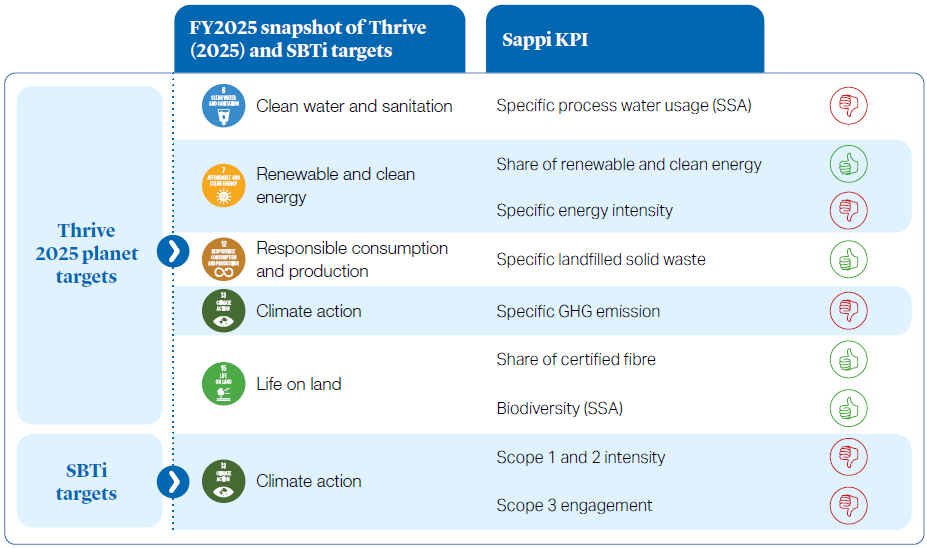
Global targets for 2025 for specific total energy and specific
GHG emissions were not achieved. The primary reason for the
poor performance against our targets is the market-related
production curtailment that was required during the year,
which significantly reduced the efficiency of our operations.
In addition, the North American operations were negatively
impacted by process instability introduced by the Somerset
Mill PM2 conversion and expansion project, which was
completed and commissioned during the year. However, the
renewable and clean energy target was achieved, reflecting
the strong progress made through our fuel-switching initiatives
and renewable energy procurement strategy. The waste-to-landfill
target was achieved and exceeded the 2025 goal.
Specific water usage is an SSA-specific target. The target
was not achieved due to incidences of unstable operating
conditions during unplanned production outages and product
quality challenges, which required additional water usage
as well as lower production volumes than planned for 2025.
The global certified fibre target of >75% was exceeded, and
we achieved 78%. In terms of our biodiversity improvement
target for our own forest operations, a cumulative improvement
of 25% has been achieved from the 2020 baseline condition,
well in excess of our 10% target.
Read more on Sappi's material issues relating to sustainable
forestry, biodiversity, climate change, water stewardship,
resource efficiency and minimising waste in our 2025 Sappi
Group Sustainability Report.
Science-based targets (SBTs)
The 2025 Scope 1 and 2 emission intensity of 762 t CO2e/adt
was above our SBTi trajectory due to ongoing market-related
production curtailments and the completion and
commissioning of the Somerset Mill PM2 conversion and
expansion project and its associated negative impacts
on energy efficiency. However, we achieved a reduction of
5% versus 2024 and a 15% reduction from the 2019 baseline.
FY2025 and long-term GHG emissions data
| |
GRI
reference |
Unit |
2019 |
2020 |
2021 |
2022 |
2023 |
2024 |
2025 |
| Scope 1 |
305-1a |
t CO2e/annum |
4,441,329 |
4,103,760 |
4,296,971 |
4,112,099 |
3,506,813 |
3,202,668 |
3,174,735 |
| 305-4 |
kg CO2e/adt |
664.2 |
710.4 |
682.3 |
618.0 |
703.0 |
618.6 |
617.5 |
| Scope 1 emissions from |
|
|
|
|
|
|
|
|
|
| CO2 |
305-1b |
t CO2e/annum |
4,098,832 |
3,762,801 |
3,960,852 |
3,774,529 |
3,171,556 |
2,871,303 |
2,848,209 |
| CH4 |
t CO2e/annum |
284,607 |
286,743 |
282,637 |
284,132 |
282,878 |
277,787 |
269,142 |
| N2O |
t CO2e/annum |
57,890 |
54,216 |
53,482 |
53,438 |
52,379 |
53,578 |
57,384 |
| Biogenic emissions |
305-1c |
t CO2e/annum |
7,073,874 |
6,803,390 |
6,621,873 |
6,877,140 |
6,728,999 |
6,847,713 |
7,198,646 |
| Scope 2 |
305-2 |
t CO2e/annum |
1,529,346 |
1,188,359 |
1,146,302 |
1,325,659 |
1,076,535 |
924,179 |
742,900 |
| 305-4 |
| kg CO2e/adt |
228.7 |
205.7 |
182.0 |
199.2 |
215.8 |
178.5 |
144.5 |
| |
305-4 |
t CO2e/annum |
5,970,675 |
5,292,119 |
5,443,274 |
5,437,758 |
4,583,347 |
4,126,847 |
3,917,636 |
| Scope 1 and 2 GHG emissions |
kg CO2e/adt |
892.9 |
916.1 |
864.4 |
817.2 |
918.8 |
797.2 |
762.0 |
| |
t CO2e/US$ million |
1,039.1 |
1,148.2 |
1,034.0 |
745.3 |
789.0 |
756.1 |
722.8 |
| Scope 3 |
305-3a |
t CO2e/annum |
3,935,961 |
3,323,710 |
3,470,153 |
3,748,614 |
3,430,897 |
3,721,925 |
4,482,363 |
| 305-4 |
kg CO2e/adt |
588.6 |
575.4 |
551.0 |
563.3 |
687.8 |
718.9 |
871.9 |
Production curtailments continue to impact emission intensity since production is the denominator in the calculation. Sappi's
absolute emissions have reduced by 34% since 2019 and benefited from the closures of Stockstadt and Lanaken Mills in
Europe. The majority of the sales volumes from the two closed mills were transferred to Gratkorn and Ehingen Mills, which have
lower emission intensity, thereby positively reducing both the absolute emissions and emission intensity of the European region.
Group absolute GHG emissions trend
Scope 1 and 2 emissions reduced by 34% since 2019
Scope 1 emissions reduced by 29% since 2019
Scope 2 emissions reduced by 51% since 2019
Group absolute GHG emissions

Although the 2025 emission intensity remains above our
SBTi target trajectory, this is to a large extent due to the
production curtailments and the impact on operational
efficiencies. The key abatement capital projects that have
been completed in the last few years are demonstrating
significant emission reductions.
In terms of the abatement projects, we have achieved
significant reductions in Scope 1 emission intensity from
the four main projects listed below.
- Kirkniemi Mill Scope 1 emission intensity reduced
by 84% from the 2019 baseline, corresponding to
an absolute reduction of 87%, driven primarily by
the conversion of the coal-fired boiler to biomass.
- Gratkorn Mill Scope 1 emission intensity reduced
by 34% from the 2019 baseline, corresponding to
an absolute reduction of 52%, due to the conversion
of the coal-fired boiler to natural gas/biomass. Intensity
will reduce even further as the final phase of the project
to handle biomass is completed and the boiler converts
fully to biomass.
- Maastricht Mill Scope 1 emission intensity reduced
by 6% from the 2019 baseline, corresponding to an
absolute reduction of 15%, as e-boiler benefits were
realised.
- Saiccor Mill Scope 1 emission intensity reduced
by 45% from the 2019 baseline, corresponding to an
absolute reduction of 42%, due to the sustainability
investments included in the recent expansion project.
In terms of our engagement target for Scope 3 to have 44%
of our suppliers by spend with SBTs by 2026. In 2025, 23%
of our suppliers by spend have set SBTs. By region, the
performance was SEU 25%, SNA 19%, and SSA 25%. Delays
in SBTi finalising their guidance for the chemical sector
have constrained a number of our suppliers setting SBTs.
We anticipate that more of our chemical suppliers will join
SBTi after the guidelines are published for the sector –
expected by the end of calendar year 2025.
Limited assurance
In 2025, we engaged KPMG to perform limited assurance on the following planet variables:
- Scope 1 and 2 GHG emissions
- Scope 3 GHG emissions: category 1 – purchased goods and services
- Solid waste-to-landfill
- Certified fibre
- Specific process water usage (SSA only).
Enabling a just transition
Sappi recognises that a just transition
to a low-carbon economy requires not
only technological change, but also social
inclusion and capacity building beyond our
own workforce. In South Africa, where the
company's operations are deeply rooted,
the shortage of technical and green
economy skills presents both a challenge
and an opportunity.
Sappi is fully committed to a just transition that places our
people at the centre of our sustainability journey. In 2025, we
implemented dedicated metrics to monitor and understand
the impact of our transition on our workforce, ensuring
transparency and accountability. Our goal is to achieve our
climate and sustainability objectives without any direct job
losses linked to this transition. Where changes to roles or
operations are necessary, we are committed to reskilling and
redeploying our employees, equipping them with the skills
needed for a low-carbon, circular future, while maintaining
meaningful employment across our operations.
| Impact of climate
transition actions
on our workforce |
FY2025 |
FY2019 to
FY2024 |
| Number of permanent
jobs lost |
0 |
0 |
| Number of permanent
jobs created |
1 |
98 |
| Number of employees
reskilled and redeployed |
0 |
15 |
Sappi Southern Africa is building green skills and economic
resilience by advancing sustainable livelihoods and future-ready
employment through targeted community skills
development initiatives. Central to this effort is our artisan
training programme, which offers comprehensive
apprenticeships in key trades such as millwrighting, fitting
and turning, electrical work, and boiler-making. Each year,
between 105 and 120 apprentices are trained in Sappi's
modern facilities, with more than 90% absorbed into the
company or its contractors. To address educational barriers
in rural areas, a pre-apprenticeship bridging course introduced
in 2019 has helped over 60 young participants to date
to strengthen foundational skills and transition into full
apprenticeships. In the forestry sector, Sappi has trained
309 small growers and contractors in 2025 in silviculture,
harvesting, and environmental certification across KwaZulu-Natal
and Mpumalanga, enhancing alignment with international
standards such as FSC™ and PEFC while fostering local
enterprise development. Together, these initiatives support
a just transition by equipping communities with green
economy skills, promoting inclusive economic growth, and
reinforcing the link between climate action, social equity,
and environmental stewardship.
Conclusion
A number of physical and transitional risks and opportunities
have been identified related to climate change, and we
continue to monitor developments with respect to legislation,
markets, technology, and disclosure requirements.
We believe that we have the right strategy
to address the risks and opportunities
arising from climate change and will
continuously enhance our scenario
modelling to expand our thinking and
ensure that our strategy and transition plan
remains resilient. We recognise that the
successful implementation of our transition
plan depends on balancing abatement
investments with capital availability and
social impacts to ensure a just transition.