Nature is fundamental to Sappi's identity and long-term success. Our business is built
on responsibly sourced, renewable woodfibre and the ecosystem services that support forest
health, water security and climate stability. As we continue to strengthen our contribution
to a regenerative and nature-positive world, we are aligning with the Taskforce on Nature-related
Financial Disclosures (TNFD) framework to enhance the transparency, robustness
and decision-usefulness of our reporting. Our aim is to provide stakeholders with clear insight
into how nature-related dependencies, impacts, risks and opportunities inform our strategy,
operations and value-creation model. We are progressing toward full TNFD-aligned disclosure
within the next two years ensuring our stakeholders have clear insight into how we manage
and respond to nature-related issues across our value chain.
Our commitment to nature-positive
outcomes
We are committed to implementing nature-positive actions
and continuously reducing our impacts on nature through
strong water stewardship, sustainable forestry practices,
biodiversity enhancement, and climate action to reduce
GHG emissions, recognising the deeply interconnected nature
of these systems. We mitigate and reduce the impacts of our
manufacturing operations on nature through a disciplined,
continuous improvement approach. Our air emissions, effluent
discharges, and solid waste are governed by stringent legal
requirements, operational permits, and licences, and we meet
all applicable regulations in the regions where we operate.
We seek to implement value-enhancing best available
technologies wherever appropriate to further reduce our
environmental footprint. We continuously monitor our outputs
into the environment and provide transparent reporting
to regulators and other stakeholders as required, reinforcing
our commitment to responsible, sustainable operations.
Governance
Oversight of nature-related issues is integrated into Sappi's
broader Sustainability Governance Framework, which ensures
strong accountability and cross-functional coordination
across the business. The board of directors provides strategic
oversight of environmental and sustainability matters,
supported by executive management and specialised teams
in forestry, manufacturing, procurement, risk, finance and
sustainability.
For more on our sustainability governance structure see
our 2025 Sappi Group Sustainability Report www.sappi.com/2025GSDR.
Policies on environmental management, water, climate
and responsible woodfibre sourcing, guide our business
practices, while forest certification systems Forest
Stewardship Council™ (FSC™ N003159), Programme for
the endorsement of Forest Certification (PEFC/01-44-43),
SFI® and ISO 14001 provide external verification and
reinforce our commitment to responsible environmental
stewardship. Our governance ensures that nature
considerations are embedded in our decision-making
structures, capital allocation processes and long-term
strategic planning.
Strategy
Nature is integral to who we are. Sappi's value proposition
and Thrive strategy are underpinned by the sustainable
and renewable qualities of woodfibre, which is dependent
on healthy forests, resilient landscapes and the ecosystem
services they provide. Recognising this, we integrate nature
considerations into our organisational strategy and core
business processes.
Our nature-related strategic priorities include:
- Ensuring long-term security of fibre supply through
certified, responsibly managed forests and sourcing
practices
- Conserving and restoring biodiversity across our forestry
landholdings
- Strengthening water stewardship, particularly in water-stressed
catchments where our operations are located
- Reducing GHG emissions and enhancing climate resilience
across our forest and mill operations
- Continuously optimising resource efficiency and
minimising emissions, effluent and waste through
operational excellence and best available technologies
- Focus on circular manufacturing and product innovation.
These priorities align with our decarbonisation roadmap,
circularity ambitions and broader sustainability commitments.
They also reflect our recognition that climate, water, forests
and biodiversity are deeply interconnected, requiring holistic
management. As we move toward full TNFD adoption, we
are looking for opportunities to further integrate nature-related
considerations into operational planning, innovation,
stakeholder engagement and long-term strategy development.
Nature-related risk and opportunity management
Sappi incorporates nature-related risks and opportunities
into our enterprise risk management (ERM) system. This
ensures that risks linked to nature degradation, biodiversity
decline, water scarcity, climate-driven ecosystem shifts and
evolving regulatory requirements are monitored, assessed
and managed proactively.
Physical risks
- We periodically assess and monitor risks such as changes
in forest productivity, wildfire incidence, invasive pests
and pathogens, water scarcity and potential degradation
of ecological assets that underpin our value chain
- We mitigate the impacts of our manufacturing operations
on nature through a disciplined, continuous improvement
approach, governed by stringent legal requirements,
permits and licences for air emissions, effluent discharges
and solid waste, supported by rigorous monitoring and
transparent reporting to ensure we meet or exceed all
applicable regional regulations.
Transition risks
- We monitor evolving regulatory, certification and market
requirements related to sustainable forestry, emissions,
biodiversity conservation and nature-positive reporting
to assess the impact on Sappi's operations
- Growing customer preference for low-impact, renewable
materials is also shaping market dynamics
- Stakeholder expectations regarding responsible sourcing
and environmental performance are increasing. We manage
these risks through rigorous forest certification, supplier
engagement and continuous improvement across our
operations.
Opportunities
Our dependence on renewable woodfibre positions
us strongly to benefit from nature-positive opportunities.
These include:
- Expanding forest certification
- Supporting small growers through inclusive forestry
programmes to build shared value
- Enhancing biodiversity value on our landholdings
- Advancing circular, biobased product innovations
- Increasing resource efficiency and beneficiating waste
streams
- Advancing partnerships in water stewardship and
conservation.
Nature-related considerations therefore play an important
role in strengthening the resilience of our business model
and creating long-term value.
Risk mitigation through forest certification
Forest certification systems are a key risk mitigator for
Sappi in addressing deforestation, forest degradation
and biodiversity impacts within our forestry operations
and woodfibre supply chains. The certification schemes
we work with – FSC™, PEFC and SFI® – are effective tools
that promote sustainable production and responsible
forest management. These systems establish stringent
requirements for forest management, woodfibre sourcing,
traceability and Chain of Custody tracking, and are
underpinned by independent third-party auditing. Forest
certification delivers positive impacts by strengthening forest
management practices and applying rigorous due diligence
in woodfibre supply chains to ensure that all woodfibre,
including non-certified inputs, comes from controlled,
non-controversial sources. Forest management practices
required by certification, such as retaining deadwood,
protecting wetlands, maintaining riparian buffer zones,
maintaining diverse species composition and safeguarding
key biotopes, help secure biodiversity within working forests.
Healthy, robust, well-managed forests support community
wellbeing, provide a haven for wildlife and diverse plant
species, protect watersheds and play a critical role in the
carbon sequestration cycle. The forest certification systems
that Sappi works with all have requirements within their
forest management standards, which focus on maintaining
or enhancing biodiversity and managing or protecting high
conservation and ecosystem values. Through the inclusion
of these requirements in forest management practices,
attention is placed on maintaining and conserving biodiversity
while implementing other management objectives. The impact
of forest certification standards also extends beyond certified
forests. FSC™, PEFC and SFI® require the conservation
of critical biodiversity values during all harvesting activities,
including those on non-certified forestlands, through
implementation of a due diligence system and risk-based
mitigation measures, where necessary.
Metrics and targets
Regulatory compliance defines the baseline expectations
for operational performance. We pursue the implementation
of best available technologies where appropriate. Our
monitoring systems generate data for internal decision-making
and for required reporting to regulators and
stakeholders. To support progress toward our nature-related
targets, we report comprehensive metrics across air
emissions, energy use, water and effluent, solid waste and
forestry operations. Through our double materiality
assessment process, we have identified key material
nature-related issues that are central to our business and
value chain, including sustainable land management and
forestry practices, water stewardship, biodiversity protection,
resource efficiency and reducing waste. These focus areas
guide our actions and enable transparent monitoring
of performance and continuous improvement in alignment
with TNFD recommendations.
Sappi reports on a robust set of nature-related metrics
across forestry, water, climate, and biodiversity. Key targets
and performance are noted below:
Forestry and biodiversity
- Share of woodfibre sourced from certified sources
- Biodiversity improvement in our forestry landholding (SSA)
- Sustainable growth in our plantations (SSA).
Waterstewardship
- Specific water use (SSA).
Climate and energy
- GHG emissions (Scope 1, 2 and relevant Scope 3)
- Renewable and clean energy usage
- Energy intensity.
Waste
- Specific landfilled solid waste.
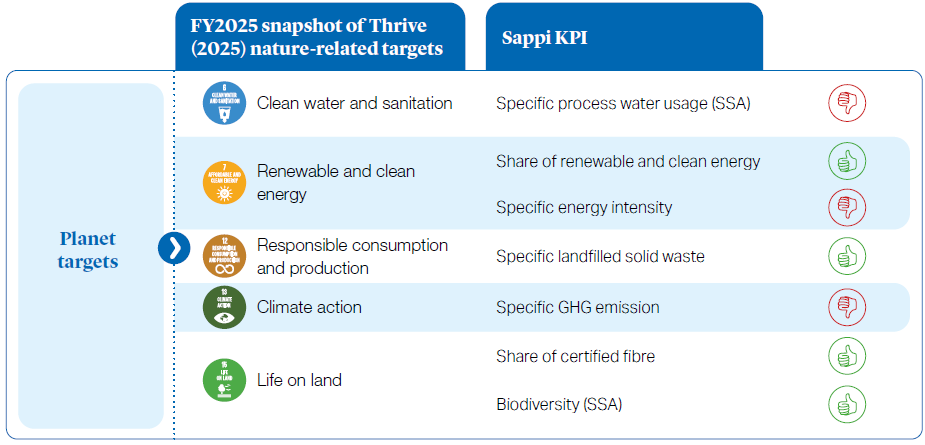
See our 2025 Sappi Group Sustainability Report for more details on our performance www.sappi.com/2025GSDR.
In addition to these key targets we also monitor and report extensively against numerous KPIs related to air emissions, water and effluents,
waste utilisation, diversion and disposal and forestry, see our 2025 planet indicators www.sappi.com/sustainable-purpose.
Conserving and restoring biodiversity in our
forestry landholdings in South Africa
In South Africa where Sappi is one of the country's major
landowners, we manage and lease 405,103 hectares of land.
Of the total land managed and leased, approximately
264,275 hectares are planted with commercial plantation
forestry, and the remaining 140,828 hectares consist
of natural areas that are managed for biodiversity. Our
plantations are dual certified against FSC™ and PEFC
standards.
Sappi invests in biodiversity and conservation in numerous
ways, including:
- Maintaining 156 important conservation areas (ICAs)
including seven (soon to be eight) nature reserves on
our plantations
- Monitoring water quality: We use the aquatic biomonitoring
South African Scoring System methodology to determine
the composition of macroinvertebrate in rivers on our
landholdings, as a measure of river health
- Developing and implementing long-term integrated weed
management plans on all our plantations as invasive alien
plants are widely considered as a major threat to biodiversity,
human livelihoods and economic development
- Maintaining and enhancing soil function – a crucial
component of sustainable forest management and
biodiversity. The trees are deep rooted and long-lived, with
little or no mechanical cultivation occurring. As a result, the
structure of soils is maintained or improved, while topsoil
nutrients are increased as nutrients and minerals are taken
up deep within the soil profile
- Partnering with conservation agencies, including, Ezemvelo
KZN Wildlife, Mpumalanga Tourism and Parks Agency and
the South African National Biodiversity Institute (SANBI),
and other plantation owners through Forestry South Africa,
to mainstream biodiversity into the forestry sector.
Sappi's nine priority locations
As part of our commitment to the Taskforce on Nature-related
Financial Disclosures (TNFD), we have initiated
assessments using the LEAP framework, beginning with our
own forestry landholdings. Through this process, we have
identified nine priority locations – eight formally proclaimed
nature reserves (including Karkloof Blue Butterfly Nature
Reserve, expected to be gazetted in 2026) and one World
Heritage Site. All sites are actively managed and form part
of South Africa's Biodiversity Stewardship Programme,
administered by SANBI through partnerships with
landowners, conservation authorities, and NGOs to secure
areas of high biodiversity value. Among these is the
Makhonjwa Mountain World Heritage Site, internationally
recognised for its globally significant geology and
exceptional biodiversity. Sappi owns a portion of the site,
which is protected under multiple national heritage and
environmental laws and governed through a collaborative
integrated management plan, with Sappi participating
actively in its implementation. Our nature reserves are
integrated within plantation landscapes and are managed
through annual plans of operation, where site-specific
impacts and mitigation measures are identified and
addressed. The South African Protected Areas Act further
provides the legal framework for the protection and
management of nature reserves. Nature reserves are national
assets declared on properties with high biodiversity
importance and have long-term title deed restrictions,
which mean that even if the land changes hands its status
as a protected area remains in place. Our nature reserves
form part of a network of natural habitats that are conserved
by setting aside portions of our landholdings for conservation,
ensuring that indigenous flora and fauna thrive alongside
commercial forestry operations. Sustainable forest
management is a key focus, with Sappi adhering to FSC™
and PEFC standards, which promote responsible planting,
harvesting, and replanting practices that help maintain
ecosystem balance. We actively control invasive alien plant
species to prevent them from outcompeting native species,
preserving the integrity of local biodiversity. To protect
aquatic ecosystems, we establish protective buffer zones
around rivers, wetlands, and other water resources, reducing
risks of habitat degradation. Fire management is another
critical aspect, we perform controlled burns to prevent
uncontrolled wildfires, which can severely damage grassland
ecosystems. Furthermore, we invest in ongoing biodiversity
monitoring and research, enabling the tracking of impacts
and continuous refinement of conservation efforts
to support the long-term health of habitats and ecosystems.
Building on this foundational work in our landholdings, our
next focus is to undertake biodiversity risk assessments for
our manufacturing operations.
| |
|
|
|
|
Geolocation1 |
| Reserve name |
Location |
Sappi
Plantation |
Area
(ha) |
Date declared |
X – DD |
Y – DD |
X – DMS |
Y – DMS |
| Clairmont
Nature Reserve |
Bulwer |
Clairmont |
1,010 |
November 2013 |
29.747 |
-29.755 |
29° 44’ 49.2” E |
29° 45’ 18” S |
| Roelton Nature
Reserve |
Ixopo |
Sutton |
114 |
October 2020 |
29.98 |
-30.124 |
29° 58’ 48” E |
30° 7’ 26.4” S |
| Karkloof Nature
Reserve |
Karkloof East |
Demagtenberg |
223 |
August 2012 |
30.2 |
-29.323 |
30° 12’ 0” E |
29° 19’ 22.8” S |
| Ngodwana Valley Nature Reserve |
Camelot South |
Nooitgedacht |
965 |
April 2017 |
30.615 |
-25.637 |
30° 36’ 54” E |
25° 38’ 13.2” S |
| Angle Ridge
Nature Reserve |
Twello |
Highlands |
1,095 |
April 2017 |
31.11 |
-25.822 |
31° 6’ 36” E |
25° 49’ 19.2” S |
| Oosterbeek
Nature Reserve |
Twello |
Highlands/ Montrose |
1,900 |
April 2017 |
31.028 |
-25.846 |
31° 1’ 40.8” E |
25° 50’ 45.6” S |
| Mount Morgan
Nature Reserve |
Twello |
Montrose |
1,013 |
April 2017 |
30.965 |
-25.863 |
30° 57’ 54” E |
25° 51’ 46.8” S |
| Karkloof Blue Butterfly Nature Reserve2 |
Karkloof East |
Shafton |
26 |
October 2025 |
30.244 |
-29.408 |
30° 14’ 38.4” E |
29° 24’ 28.8” S |
| The Barberton Makhonjwa Mountains |
|
|
|
|
|
|
|
|
The Barberton Makhonjwa Mountains
UNESCO World Heritage Site |
Twello |
Highlands/
Montrose |
20,460 |
July 2018 |
31.028 |
-25.846 |
31° 1’ 40.8” E |
25° 50’ 45.6” S |
1 Geolocation coordinates provided are for the centre point of Sappi's plantation in which the reserve is located.
2 The Karkloof Blue Butterfly Nature Reserve is expected to be gazetted in 2026.
See our 2025 Sappi Group Sustainability Report for more details on our soon to be gazetted eighth nature reserve – The
Karkloof Blue Butterfly Nature Reserve, home of the endangered Karkloof blue butterfly www.sappi.com/2025GSDR.
We recognise that it is our legal and environmental
responsibility to prevent the spread of commercial forestry
species beyond our landholdings, as these species are
classified as Alien and Invasive Species (AIS) under the
National Environmental Management: Biodiversity Act, 2004.
To meet our duty-of-care obligations and protect surrounding
ecosystems, we have established a proactive approach
to managing escapees on neighbouring properties. Our
Environmental Department has developed an Escapee
Management Policy that defines clear procedures for control
and eradication, and we have introduced a GIS Escapee
Tracking Tool that spatially records confirmed escapees
across operations, including affected landowners, contact
details and exact locations. This system enables effective
management and quantitative monitoring of progress.
By actively preventing and managing the spread of
commercial species, we contribute to biodiversity
conservation and reinforce responsible forestry practices.
Driving conservation through collaboration
Environmental and biodiversity conservation is most
effective when organisations work together toward shared
goals. Recognising that nature-related challenges are
complex and require holistic solutions, we actively pursue
partnerships that amplify impact beyond what any single
entity can achieve alone. Sappi Forests proactively engages
with several organisations to promote environmental
stewardship and enhance biodiversity outcomes on our
land. Through our partnership with Ezemvelo KZN Wildlife,
we conduct joint monitoring and leverage specialist scientific
expertise to inform intervention measures and best-practice
approaches that safeguard biodiversity. This collaboration
has confirmed the continued presence of threatened and
endangered species of high-conservation significance within
Sappi conservation areas and plantations, strengthening our
ability to protect them. Specifically on our own landholdings
we lead the Bulwer Medicinal Plant Programme in collaboration
with plant users, Ezemvelo KZN Wildlife and Tim Neary,
offering training and workshops to promote sustainable
harvesting and self-propagation of high-value medicinal
plants. The programme aims to reduce the exploitation
of wild plant populations on Sappi land for traditional and
commercial use, demonstrating the power of partnership
in driving long-term conservation outcomes.
Our collaboration with WWF through the uMkhomazi Water
Stewardship Project strengthens nature-positive outcomes
across the catchment by restoring ecosystem health
and improving water security. Working alongside local
communities, government and conservation partners,
the project focuses on clearing invasive alien vegetation,
rehabilitating degraded wetlands and riparian zones, and
promoting sustainable land-use practices that benefit
people and biodiversity. These interventions help increase
streamflow, restore native habitats, support livelihoods and
build long-term catchment resilience – demonstrating how
collaborative water stewardship can deliver meaningful
environmental and social impact.
See our 2025 Sappi Group Sustainability Report for more
details on this project in 2025 www.sappi.com/2025GSDR.
In 2025, Sappi's Forestry Environmental Department led
a series of stakeholder engagement and awareness
initiatives designed to promote environmental stewardship
and support our sustainability objectives. Three key
campaigns were hosted throughout the year: National Water
Week (20 to 26 March), International Day of Biological Diversity
(22 May), and Arbor Week (1 to 7 September). These initiatives
aimed to deepen understanding of critical environmental
themes, encourage sustainable practices among employees
and community stakeholders, and align operational behaviour
with national and global environmental priorities. Activities
included educational workshops, field demonstrations,
tree planting, river health assessments, and discussions
on ecosystem services, showcasing practical actions that
protect natural resources. In addition, we hosted members
of the PEFC Group Scheme and Sappi Forestry colleagues
for an immersive visit to the Sappi Saiccor Mill, offering
insight into the full value chain from plantation to pulp
production and reinforcing the importance of certification,
shared responsibility, and collaboration in advancing
responsible forestry and sustainable growth. These
engagements strengthened relationships, enhanced
awareness and supported our broader commitment to
creating shared value.
Biodiversity enhancement in our forestry landholdings
In support of our commitment to protect and enhance nature
within the landscapes in which we operate, we set a five-year
Thrive target in 2020 to improve biodiversity in our
conservation areas by 10%. This target supports our broader
sustainability ambition and aligns with global expectations
for nature-positive outcomes. In pursuing this goal, we have
focused on evidence-based biodiversity management,
ecological restoration and active conservation planning
across our conservation landholdings. Progress is monitored
through robust ecological surveys, biodiversity assessments
and performance indicators that enable us to track
ecosystem services.
Our biodiversity improvement project focused on enhancing
the ecological condition of selected ICAs in KwaZulu-Natal
and Mpumalanga by applying targeted management
interventions and measuring impact, using the change
in the condition-adjusted hectares (CAH) metric, which
reflects not only the physical area of an ecosystem but also
its ecological health and its capacity to deliver ecosystem
services. Using a standardised baseline assessment across
150 ICAs and annual monitoring through rapid ecological
scoring, 573 specific management interventions were
implemented between 2021 and 2025 across 72 priority
ICAs, including actions such as rotational burning, invasive
alien plant control, erosion management, cattle and access
control, and wetland and riverine protection. As a result,
both KwaZulu-Natal and Mpumalanga ICAs far exceeded
our target of a 10% improvement in biodiversity, achieving
21.6% and 29.4% improvements respectively, with an overall
gain of 25.3% from baseline. Statistical analysis confirmed
a significant improvement in ecosystem condition between
2020 and 2025 attributable to these interventions. While
priority ICAs received targeted annual interventions,
remaining areas continued to be managed under Sappi's
standard conservation practices. Through the integration
of the CAH metric, consistent monitoring and adaptive
management, the project achieved measurable improvements
in ecosystem functionality, contributing to long-term
ecological resilience and enhanced biodiversity outcomes.
Looking ahead to 2030, we have expanded our biodiversity
targets across our South African forestry landholdings and
extended our focus to our manufacturing operations, where
we have set a group-wide target to conduct biodiversity risk
assessments for all sites.
For more information, see our 2030 targets
www.sappi.com/sustainable-purpose.
Taking nature-positive action
Since 2014, Sappi's Rare, Threatened and Endangered
Species Programme has taken a collaborative, nature-positive
approach to conserving South Africa's most
vulnerable indigenous plants through partnerships with
leading research and conservation institutions including the
Agricultural Research Council, SANBI and SANParks. Sappi
uses its nursery propagation expertise to produce high-quality
seedlings of rare and threatened species, enabling
large-scale restoration efforts and providing cultivated
alternatives that help relieve harvesting pressure on wild
populations. The programme began with Warburgia salutaris (the Pepper-bark tree), which is highly valued in traditional
medicine where its bark and leaves are commonly used
to treat ailments such as colds, coughs, chest infections,
fever and digestive disorders. Sappi has produced more than
140,000 cultivated specimens which have been planted
across Kruger National Park operations and KwaZulu-Natal,
with approximately 22,000 plants supplied to local
communities each year to reduce pressure on wild
populations. This success, underpinned by a 75% rooting
rate achieved in our nurseries in 2025, contributed to the
species being reclassified from endangered to vulnerable.
The programme has since expanded to four additional
threatened species, with ongoing propagation research and
innovative techniques to preserve genetic diversity and
support sustainable use. Working closely with traditional
healers and conservation partners, the programme blends
ecological science with cultural and economic needs,
safeguarding biodiversity while supporting livelihoods, with
plans to expand to additional species to further strengthen
resilience and protect South Africa's natural heritage.
See our 2025 Sappi Group Sustainability Report for
more details on our biodiversity actions in 2025
www.sappi.com/2025GSDR.