Every trail we follow is shaped by people – the communities we serve, the
teams we empower, and the values we uphold. At Sappi, we believe that
sustainable progress begins with understanding local needs and
investing in shared value.
Like the fox navigating snow-covered terrain, we move with agility and
intent – alert to change, guided by experience, and grounded in ethical
purpose. This instinctive adaptability mirrors our approach: making smart
decisions swiftly, with courage and integrity, and always with safety
foremost in mind.
The communities beyond our fence lines are places we are also proud
to call home. Their prosperity is not only linked to our own – it is deeply
valued and actively nurtured. Our social impact approach is collaborative.
We partner with communities to jointly identify and leverage
opportunities that support local needs while aligning with Sappi’s
purpose. While each region has its own programmes, they share
common themes – forestry-related activities, environmental protection
and conservation, education, and community welfare.
Through targeted enterprise and supplier development (ESD)
programmes, we support local businesses and foster inclusive economic
growth. We maintain open, proactive dialogue with stakeholders to build
trust and mutual understanding.
Internally, we invest in training, succession planning, and skills
development to prepare our workforce for future demands. We manage
reputation with care and uphold ethical standards in every decision –
ensuring that our path is shaped by smart choices and ethical resolve,
moving swiftly but never at the expense of safety or integrity.
Our people-centred approach strengthens our social licence to operate
and reinforces our commitment to shared progress – with every step,
we remain alert, responsive, and purposeful.
A channel is more than a passage – it is a chosen course, shaped
by intention and skill. As we begin the next phase of our Thrive strategy,
we reflect on a journey steered with stamina, precision, and
responsiveness. Like a gondolier navigating shifting waters, we have
moved through capacity expansion, product realignment, and strategic
repositioning – attuned to our environment and guided by purpose.
At Sappi, prosperity is not defined by profit alone. It is the ability to create
enduring value – financial, social, and environmental. For shareholders,
it means disciplined stewardship and operational excellence. For
communities, it means investing in renewable resources and partnering
for shared progress. For the planet, it means embracing sustainable
solutions with eco-effective ingenuity.
Looking ahead, for the immediate future we return to our basics:
sustaining financial health, optimising asset utilisation, cash generation
and managing costs. While demand for graphic papers continues its
structural decline, our focus on market-share growth is delivering results
and reinforcing our competitive position. In the dissolving wood pulp
(DWP) segment, we remain cautiously optimistic. Despite global
headwinds, the long-term outlook is positive, and we are well-positioned
to respond with agility and clarity.
In a resource-constrained world, prosperity flows through the channels
we choose – those defined by resilience, ethical resolve, and collective
strength. As we navigate toward our next horizon, we do so with quiet
confidence and a steady hand, steering toward value that endures.
Every course we chart is shaped by our relationship with the natural
world. At Sappi, we are custodians of land and forests, committed
to using woodfibre responsibly – not only to drive business success,
but to contribute to long-term environmental and social value across
generations.
Our environmental strategy is rooted in certification, traceability, and
continuous improvement in sourcing and land management. Through
precision forestry practices, we optimise plantation health and
productivity while advancing biodiversity protection. These efforts
ensure that our raw materials are sourced from responsibly managed
plantations that meet rigorous sustainability standards.
We take proactive steps to reduce our environmental footprint. Our
operations are guided by robust environmental management systems
that help us lower emissions, conserve water, and improve energy
efficiency – often with internally generated bioenergy. As part of our
climate action strategy, we are accelerating decarbonisation across
our value chain, aligning with science-based targets and global
climate frameworks.
Stewardship at Sappi means moving beyond compliance. We integrate
circular design principles, regenerative land-use practices, and climate
resilience into our operations, balancing business needs with ecological
integrity. Our approach is intentional, adaptive, and informed by the
evolving expectations of our stakeholders and the realities of a
changing climate.
As we adjust our sails to meet the shifting tides of climate change and
global expectations, our direction remains clear: to protect, restore, and
regenerate the natural systems that sustain us, through measurable
action, transparent reporting, and continuous innovation.
Ensuring value creation through good
governance and recognition and rewards
Our voyage is powered by innovation – guided by purpose, leadership,
and a steadfast commitment to sustainability. Sappi uses renewable
resources to make woodfibre-based products, and we are a diversified,
innovative, and trusted leader focused on sustainable processes and
solutions. From dissolving wood pulp to packaging and speciality papers,
we continue to expand our portfolio with offerings that meet evolving
customer needs and rising environmental standards.
We invest in meaningful engagement across the value chain –
collaborating with customers as well as brand owners, converters, and
suppliers to unlock shared value. By listening closely and partnering
widely, we identify opportunities to enhance product performance, all the
while looking to reduce environmental impact, and supporting long-term
returns.
Our product strategy is dynamic and forward-looking, anchored
in circularity, and market relevance. Through fact-based support and
technical expertise, we help customers navigate their own ESG
challenges with confidence and clarity.
In a world transitioning from a fossil-based economy to a circular
bioeconomy, Sappi offers a compelling vision: a sustainable business
with an exciting future in woodfibre – delivering relevant solutions,
enhanced value, and trusted partnerships. Beyond our product portfolio,
we offer a suite of technical and development services supported
by highly qualified teams of technicians to improve customer efficiencies
and scientists who continuously explore new applications for woodfibre
and collaborate with customers through targeted R&D initiatives.
On this voyage of delivering traceable, responsibly sourced products,
we deploy state-of-the-art technology to ensure precision, reliability, and
transparency. Every offering is a step forward – advancing purpose-led
growth, regenerative design, and global impact. We are actively building
a circular economy that benefits both business and the world.
Just as rivers carve their course over centuries – shaping landscapes
through persistence and adaptability – our journey begins with a path
defined by nearly 90 years of resilience, reinvention, and purpose. Sappi’s
Thrive business strategy is more than a roadmap; it is a long-term
commitment to sustainable growth, operational excellence, and enduring
trust, all while creating meaningful value for our stakeholders.
As Thrive evolves, we stand at an inflection point. The environment
around us is shifting – reshaped by global forces that continue
to redefine business: climate change, resource scarcity, consumer and
employee expectations, and the rapid pace of technological innovation.
Our strategy evolves in response, slightly adjusted to remain fit for
purpose, reaffirming our commitment to building a thriving world through
renewable innovation and shared prosperity.
Our path is not static – it adapts with intention. Whether responding
to market pressures or environmental imperatives, we remain focused
on long-term value creation. Strategic clarity, technological innovation,
and disciplined execution keep us on course – propelling us forward with
purpose.
As we look ahead, our focus sharpens: sustaining financial health,
deepening stakeholder value, and unlocking opportunity through
collaboration and eco-effective ingenuity. The river may change course,
but its direction remains true.
Sappi is committed to
the highest standards of
corporate governance,
which form the
foundation for
the long-term
sustainability of
our company and
creation of value for
our stakeholders.
All directors attended
100%
of the meetings
of the board
in FY2025.
Good governance at Sappi contributes to living our values through enhanced
accountability, a transparent and ethical culture, strong risk management,
a focus on effective control of the business, legitimacy, and good performance.
Governance is one of our key enablers to unlocking and protecting value, as we
optimise the use of our capitals, address our key risks while taking advantage
of exciting opportunities (refer to Risk management), while
minimising the negative impacts of trade-offs that have to be made, as set out
in the presentation of Our key material issues.
Sappi's approach to governance is rooted in purpose-driven leadership from
both the board and executive management, supported by a strong culture of
values and expected behaviours that apply to all employees across the group.
Integrity and doing the right thing are core to Sappi's values and are actively
embedded throughout the organisation through the adoption of OneSappi.
The board and executive management are focused on creating long-term,
sustainable value by delivering on the group's purpose of ensuring that our
products and people make a difference in the everyday lives of our consumers.
This is achieved through the effective implementation of our Thrive strategy.
To maintain the relevance and sustainability of our business model, we
continuously monitor external dynamics, including macroeconomic trends,
industry risks, capital availability and stakeholder expectations. These insights
shape and inform the group's strategic direction. The board's governance
structures and processes are designed to support the effective delivery
of this strategy, while ensuring sound management and robust control
over the business. The principles of King IV are firmly embedded in the group's
internal controls, policies, board charters and governance practices. Sappi is
proceeding with a gap analysis between King IV and King V to facilitate
early adoption. The board's oversight responsibilities are aligned with its
commitment to achieving the four governance outcomes advocated
by King IV: ethical culture, effective control, good performance and
legitimacy. For further details on how Sappi applies the King IV principles,
please refer to the King IV Register available on our website at
www.sappi.com/investors/corporate-governance-and-risk.
Sappi is listed on the JSE Limited and complies in all material respects with the
JSE Listings Requirements, regulations and codes. Sappi subscribes to full
compliance with the Companies Act, and the relevant laws governing its
establishment, specifically related to its incorporation.
In compliance with paragraph 7.F.6 of the JSE Listings Requirements, the board
confirms that the company continues to comply with the provisions of the
Companies Act and operates in conformity with its memorandum of
incorporation (MOI) and/or relevant constitutional documents.
The board is constituted in accordance with the company's MOI and the
principles of King IV. The majority of board members are Non-executive
Directors who bring diverse perspectives to board deliberations and add value
by constructively challenging management. We believe that the current
composition provides the appropriate leadership to guide the business into
the future. However, where necessary, we will appoint new directors whose
experience supports the company's strategic direction and industry focus,
and who contribute to maintaining the desired diversity on the board.
The board of directors
The basis for good governance at Sappi is laid out in the
board charter, which sets out the division of responsibilities
between the board and executive management. The board
creates and preserves sustainable value by collectively
determining strategies, approving major policies and plans,
taking responsibility for risk management, and providing
oversight as well as monitoring to help ensure accountability.
The board is comfortable that the board charter ensures
a clear division of responsibilities between management and
the board and that no director has unfettered authority.
The board is satisfied that it has fulfilled its responsibilities
in accordance with its charter for the reporting period.
Mr Nkululeko Sowazi, our Non-executive Chairman, leads
the board in the objective and effective execution of its
governance roles and responsibilities. Mr Mike Fallon
strengthens the board's independence in his capacity as the
Lead Independent Director. The roles of the Chairman and
the CEO are distinct and separate, with this division of
responsibilities designed to ensure that no individual holds
unfettered decision-making power and that an appropriate
balance of authority exists on the board. Two members of
executive management – the CEO and the CFO – serve on
the board, providing our Non-executive Directors with
multiple points of direct engagement with management.
Succession plans
In the last two years, Sappi board has seen a number
of important changes, namely the retirement of the
Chairman of the board, Sir Nigel Rudd, and appointment
of Mr Nkululeko Sowazi, the retirement of the Chairperson
of the Audit and Risk Committee, Mr Peter Mageza, and
appointment of Ms Zola Malinga, the retirement of Lead
Independent Director Mr Valli Moosa and appointment
of Mr Mike Fallon who will retire at the AGM in February 2027.
In addition, all four sub-committees have new Chairpersons:
Nomination and Governance – Mr Nkululeko Sowazi (appointed 08 February 2024)
Audit and Risk – Ms Zola Malinga (appointed 08 February 2024)
HR and Compensation – Mr Louis von Zeuner (appointed 01 January 2025)
Social, Ethics, Transformation and Sustainability – Mr Brian Beamish (appointed 01 January 2025).
Linking with the strategic direction and ensuring that Sappi has
board members with the appropriate skill sets, experience and
corporate knowledge to maintain continuity, we have further
developed our succession plans for all key roles, including the
Chairpersons of the governing body and committees and
the Lead Independent Director. The first of these will be the
Lead Independent Director successor to be announced
in November 2026. Working with outside agencies to define
the skill sets, experience and knowledge that are needed for
our future Non-executive Directors, a recruitment programme
is in place with the aim to fill future vacancies prior to
retirements, ensuring strong transfer of corporate knowledge.
Ongoing, we expect to recruit one new Non-executive Director
on average per year. Detailed induction plans are developed
for each new Non-executive Director tailored for their skill sets
and Sappi's corporate needs.
Additional changes to the composition of the board
and committee were made on 01 September 2025.
Dr Boni Mehlomakulu serves part of her remaining tenure
as a member of the HR and Compensation Committee, and
after nine months of handover to Mr Louis von Zeuner,
Mr Mike Fallon joins the SETS Committee until his retirement
in February 2027. We aim to continue to provide crosscommittee
exposure for non-executive members and
enhance overall board effectiveness.
In accordance with the company's MOI, and to ensure
accountability while maintaining continuity on the board,
one-third of Non-executive Directors are required to retire
by rotation and stand for re-election by shareholders at each
AGM. Prior to being recommended for re-election, such
directors undergo assessment by the board, which considers
their interests, independence and continued contribution.
Non-executive Directors are not appointed for fixed terms.
The Independent Non-executive Directors who have served
on the board for nine consecutive years are required
to undergo a rigorous independence assessment each year.
Board evaluation
In line with the principles of King IV, the board undertakes
an externally facilitated evaluation every two years. During
FY2025, an external evaluation was conducted under the
guidance of the Nomination and Governance Committee.
The purpose of the evaluation was to assess the board's
overall performance and effectiveness, recognise strengths,
identify areas for development, and encourage constructive
board engagement. We believe these robust plans and
actions will ensure that the Sappi board has the appropriate
governance, skills and experience to drive the company
forward. The outcome confirmed that the board continues
to operate effectively, while also highlighting areas where
further enhancements could be made. Appropriate actions
have been initiated to address these findings and support
continuous improvement. In addition, there is a rigorous
external independence assessment of those directors
who have served for more than nine years on the board.
The Sappi board and diversity
Sappi operates globally and across a variety of markets,
jurisdictions and cultures, requiring a diverse mix of
experience, skills, gender, age and backgrounds. It is
important that our board composition reflects this diversity,
both in a South African context as well as globally. The board
comprises an appropriate balance of knowledge, skills,
experience, diversity and independence to objectively and
effectively discharge its governance role and responsibilities.
It has adopted a broad diversity policy, focusing specifically
on the diversity attributes of gender, race, culture, age, field
of knowledge, skills and experience at board level.
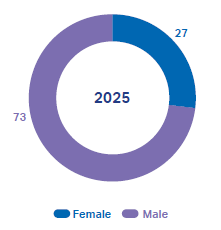
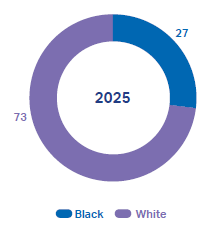
The company remains firmly committed to promoting diversity, equity and inclusion, and has adopted a policy aimed at
advancing broader diversity at board level. This policy specifically focuses on attributes such as gender and race and is duly
considered and applied when making appointments to the board.
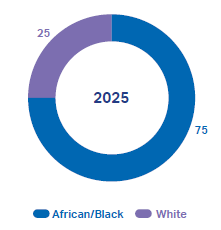
Targets have been set for 2028
Gender – 30% (applicable to all Non-executive Directors); current – (3/9) – 33%
Race – 50% of previously disadvantaged South Africans*; current – (3/4) – 75%.
*
Geographical region (geographic diversity refers to having a mix of individuals from various geographic locations on the board). For Sappi to leverage the
benefits of a globally diverse board that is aligned with its geographic footprint, race was limited to previously disadvantaged South Africans in its South
African region only.
Internal 2028 geographic target for Sappi regions
South Africa – 50%; current – (4/9) – 45%
Europe (including the UK) – 30%; current – (3/9) – 33%
North America – 20%; current – (2/9) – 22%.
Diversity
Gender (%)
Race: Board (%)
Race: SA context (Transformation) (%)
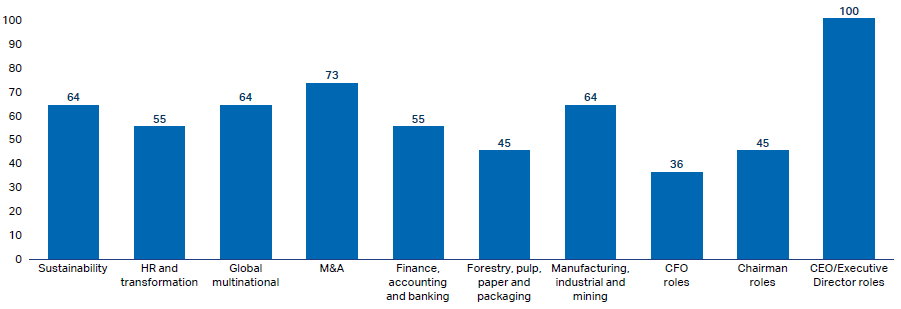
Board experience (%)
Sappi's board members have experience across multiple industries and leadership roles.
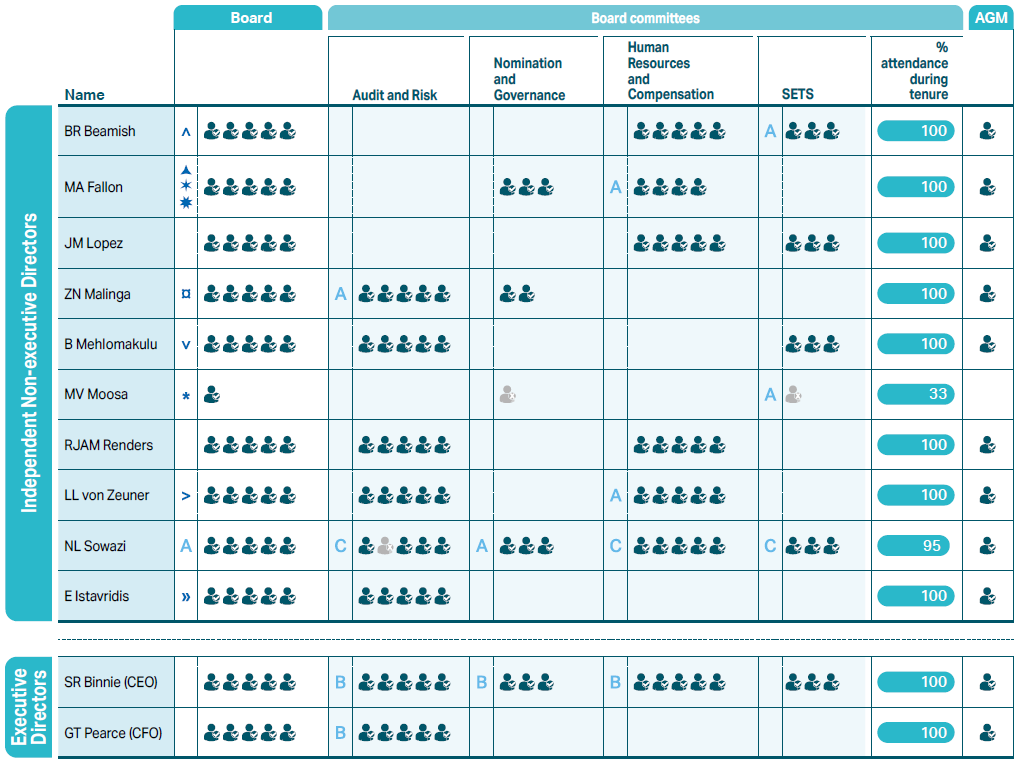
The composition of the board and attendance at board meetings and board committee meetings are set out in the table below for the year ended September 2025:
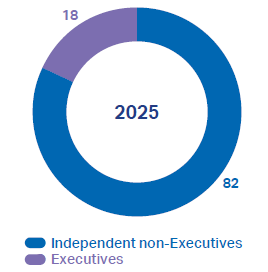
Directors' independence (%)
Directors' ages (%)
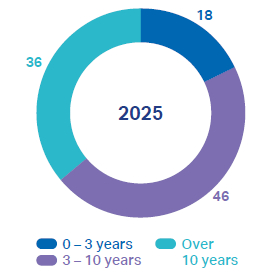
Directors' tenure (as at year-end) (%)
The board uses its quarterly meetings as a key platform to discharge its duties under the Companies Act, JSE Listings
Requirements and King IV principles. These meetings also provide a forum for setting strategic direction and overseeing risk
management. Agendas are thoughtfully prepared in collaboration between the Chairman, CEO and the Company Secretary.
In FY2025, the board focused on enhancing and protecting long-term value, while proactively addressing risks that could lead
to value erosion.
Strategic and other focus areas
The board focused on the following items in 2025:
Oversight of progress in executing the Thrive strategic plan
Review and approval of the five-year plan
Approval of the 2026 business plan
Director strategy sessions
Deep dives into the following topics:
– Tugela Mill lignosulphonate spray dryer project
– Sappi Europe strategic positioning
– Sappi North America strategy
– US tariff impacts and mitigating actions
– Dividends versus share buybacks
– Capital project executive methodology learning and update
– Companies Act amendments learning
– Global macro-strategy and asset allocation – joining the dots in asset markets
– Review and approval of the global shipping tender
– Post-completion audits of major capital projects
– Tour of Kirkniemi Mill and review of the mill strategy and capex projects
– South Africa's political and economic prospects
– Sappi Southern Africa fatalities
– SBTi gap analysis
– Thrive strategy
Monitoring of voluntary diversity targets, in accordance with the JSE Listings Requirements, relating to the policy on the promotion of broader diversity at board level
Monitoring and approval of the restructuring plans for Sappi Europe
Monitoring the economic environment in Europe and North America, including regional market peculiarities, performance, opportunities and challenges
A review of the Code of Ethics and related policies
Review of the safety report, statistics and initiatives
Oversight of the company's climate transition plan
Review of IT risks, security and cyber risk developments and monitor technology landscape
Succession planning (Executive Committee, regional lead teams and other key positions)
Executive remuneration overview
Conducted an external board evaluation
Consider the impacts of the US-announced trade tariffs
Overview of design and implementation of the Sappi Management Plan (Sappi Future Share)
Recommendation to shareholders for the approval of the increased headroom for the share incentive scheme
Refinancing of the 2026 bond and securitisation programme
Review of share performance
Consider the opinion of investors in respect of value creation
Review of technology and innovation projects
Review and approval of the Group Authorities Framework
Review of the Stakeholder Relations Report and Corporate Social Responsibility Report
Review of credit exposure (semi-annual)
Review of the loan guarantee schedule
Treasury policy review
Group insurance renewal
Consideration of paying a dividend
Oversight of HR's successful upgrade of the HR system technology and launch of Sappi's employee app
Oversight of the sale of Lomati Sawmill.
All the top risks, as well as emerging risks, have been focused on by the board during 2025.
The following areas will receive specific focus by the board in 2026:
Oversight of progress in achieving the Thrive strategic plan
Capital projects execution risks and oversight
Review the technical and innovation initiatives
Monitoring of the geopolitical tensions in Europe and the US
Monitor impact of trade tariffs
Review the progress of the mill maintenance shuts scheduled for 2026 and its impact on earnings and cash flows
Oversight of the company's climate transition plan
Review of Sappi's captive insurance entity (strategy, governance, insurance claims)
Monitoring of voluntary diversity targets
Monitor actions resulting from the employee engagement survey
Monitor developments in the technology landscape
Monitor operational efficiency and cost management at operational level
Heightened safety awareness programmes
Oversight of the implementation of the provisions of the amended Companies Act and King IV
Oversight of liquidity headroom, covenant levels and increased long-term and short-term debt risk and potential shareholder concerns in that respect
Renegotiation of covenants
Monitor progress and outcomes of the board external evaluation action items.
Throughout the year, the board regularly considered capital
allocation and soft commodity/exchange rate price volatility.
Meetings also included updates from committee chairs
on key issues and decisions arising from committee
deliberations, as well as comprehensive regional reports
covering operational and financial performance and
projections, macroeconomic and sociopolitical
developments, competitive dynamics, and the broader
operating environment. These sessions also addressed
progress on strategic implementation, value-creation efforts,
key risks and reputational issues, human capital matters and
updates on significant projects in progress.
Induction and training of directors
Following appointment to the board, directors receive
induction and all directors receive training tailored to their
individual needs. When required, RMB (sponsor) provided
training for the board on governance topics, such
as directors' liability, price sensitivity and dealing in securities.
This includes the implementation of online training for
officers, executives and Non-executive Directors on various
governance, regulatory and risk topics.
Stakeholder communication
The board is responsible for presenting a balanced and
understandable assessment of the group's position
in reporting to stakeholders. The group's reporting
addresses material matters of significant interest and
is based on principles of openness and substance over
form. The reporting includes information on key
trade-offs that have to be made. Various policies have
been developed to guide engagement with Sappi's
stakeholders such as the Group Stakeholder
Engagement Policy and Group Corporate Citizenship
Policy. The company
website and social media channels
(LinkedIn, Facebook, YouTube) underpin the stakeholder
communication programme. Sappi has a policy
addressing alternate dispute resolution (ADR) and
relevant ADR clauses are generally included in contracts
with customers and suppliers. There have been no
requests for information for the period under review
in terms of the Promotion of Access to Information Act
(South African legislation).
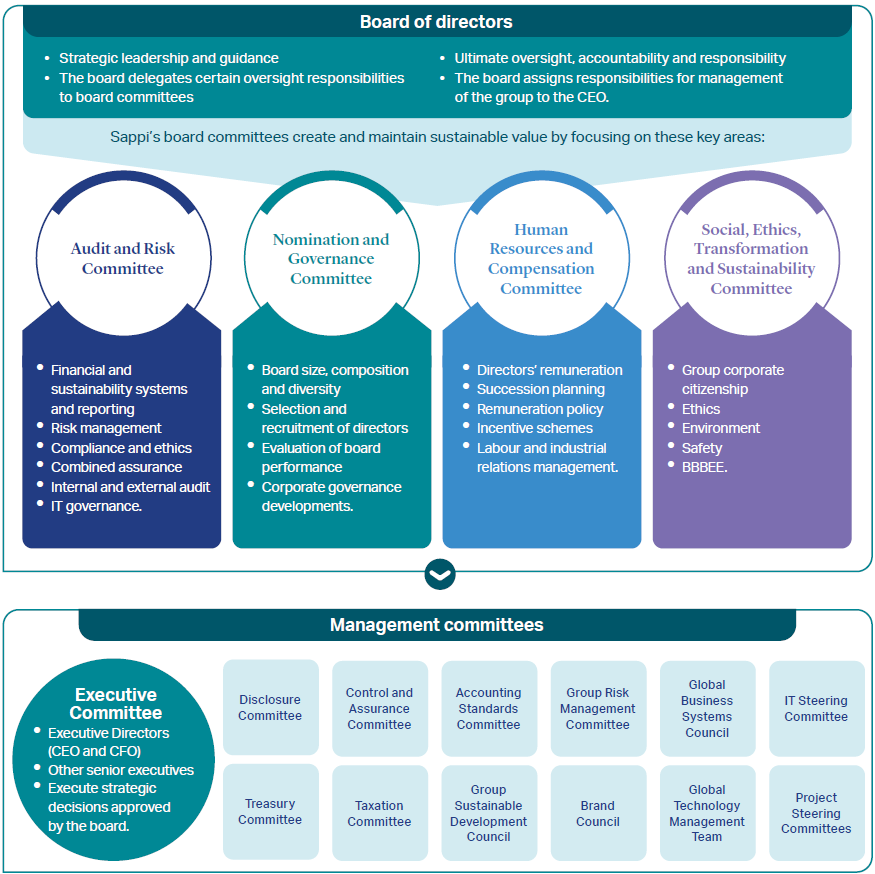
Board and management committees have been established and are discussed in the Board committees below.
The board of directors plays a central role in providing strategic direction and oversight, ensuring that long-term value is created
for stakeholders through robust governance and sound control systems. It retains ultimate accountability for the performance
and affairs of the group and ensures adherence to high standards of ethical conduct. The board is supported by well-constituted
committees, each with clearly defined mandates and formal terms of reference that are approved by the board and reviewed
annually. These committees enhance independent judgement, enable the sustainable execution of strategy, and allow the board
to leverage the specialised expertise of its members in areas such as audit, risk, sustainability and executive remuneration. While
committee members are appointed by the board, the Audit and Risk and Social, Ethics, Transformation and Sustainability
Committees require shareholder election following board nomination. Following each meeting, committee chairpersons report
back to the board, promoting transparent communication and ensuring that all aspects of the board's mandate are addressed.
The minutes of board committee meetings are also made available to all board members. The board remains satisfied that the
committees have the competence and capacity to effectively manage the group's current and emerging risks and opportunities.
Delegation of authority
The board's strategic oversight is supported by a formal Limits of Authority Framework, which defines how decision-making
powers and responsibilities are allocated throughout the group. Subsidiary boards operate within this framework and are
accountable to the board of Sappi Limited.
Board committees
The board has established committees to assist it to discharge its duties. The committees operate within written terms of reference set by the board.
Zola Malinga,(Chairperson)
Membership details at September 2025
ZN Malinga
RJAM Renders
B Mehlomakulu
LL von Zeuner
E Istavridis
100%
overall committee attendance rate
Stakeholders
The ARC has helped to create and protect value for the following stakeholders: employees, customers, shareholders and regulators.
The Audit and Risk Committee (ARC) consists of five Independent Non-executive Directors. The committee assists the board in discharging its duties with oversight of:
The risk management function
Sustainability and climate change risks, including the quality and transparency of sustainability information presented in the Annual Integrated Report and the external ESG assurance provided by KPMG
IT risks, related controls and governance. The committee continued its special focus on the increasing threats of cyber attacks and security in the operational technology area and third-party risk
Non-financial risks and controls
The safeguarding and efficient use of assets
Operation of adequate systems and control processes
The integrity of financial information and the preparing of accurate financial reports in compliance with applicable regulations and accounting standards
Combined assurance
Compliance with the group's Code of Ethics and external regulatory requirements
The external auditors' qualifications, experience, independence and performance, including a review of IRBA reporting
The review and approval of non-audit services, undertaken by external audit
The performance of the internal audit function; this included review of the results of the annual Internal Quality Assurance review and the External Quality Assurance Review
The performance of the finance function
Group treasury policies, developments, refinancing arrangements and liquidity assessment
Captive insurance matters
Risks and governance relating to joint ventures
Retirement fund risks, developments and independent assurance
Review of credit exposures
Pending litigation and legal compliance programme feedback
Land claims review, initiatives and outlook
Taxation policies, congruent with responsible corporate citizenship, including risk management, strategy and transfer pricing
Asset impairments and treatment of assets held for sale
An external review of the committee's operating effectiveness and performance every two years by way of an assessment, with feedback being provided to the board
Review and approval of the Annual Integrated Report in a joint sitting of the ARC and the Disclosure Committee
The impact of the announced US trade tariffs.
Strategic and other focus areas
The ARC helped to create and preserve value by providing oversight and guidance for a wide range of topics, including the following areas related to Sappi's strategy:
Governance and risk aspects of projects to accelerate the group's ability to take advantage of opportunities in higher-margin growth segments
Oversight of restructuring activities, risks and controls relating to the SEU region
Impact of mill maintenance shutdowns on earnings and cash flows
Cyber security incidents and disaster recovery plans
Business and IT continuity arrangements
The internal quality assurance review and external validation
Sappi's forensic activities relating to cases reported and whistle-blower arrangements
Governance and risks relating to joint venture arrangements
Consider the JSE Proactive Monitoring Report
Internal Audit GIAS Essential Conditions and how Sappi complies
Refinancing of the 2026 bond and securitisation programme
Sappi Southern Africa Limited dividend.
Areas of oversight for the committee in 2026 will include:
Additional focus on IT cyber security threats and digital developments, with a key focus on third-party risks and controls
Sustainability risks and revised reporting for ESG matters and procedures for financial reporting attestations
The roll-out of the various Global Business Systems projects and related risks and control activities
Capital, IT and business projects governance
Oversight of funding plans, including liquidity headroom,
covenant levels and increased long-term and short-term
debt risk
Capital projects execution risks
Challenging European environment and impact thereof
Impairments CGU level, particularly in Europe
Monitor progress of open issues in Sappi's Internal Control System
The ARC confirms that it has received and considered
sufficient and relevant information to fulfil its duties as set
out in the Audit and Risk Committee Report.
The external and internal auditors attended ARC meetings
and had unrestricted access to the committee and Chairman.
The external and internal auditors met privately with the ARC
during 2025.
The committee is satisfied that it has fulfilled its
responsibilities as set out in its terms of reference.
Nkululeko Leonard Sowazi,(Chairman)
Membership details at September 2025
NL Sowazi
ZN Malinga
MA Fallon
92%
overall committee attendance rate
Stakeholders
The Nomination and Governance Committee has helped to protect value primarily for the following stakeholders: shareholders and regulators.
The Nomination and Governance Committee focused on governance, independence and composition of the board, board committees and executive management positions to effectively address all material risks facing
the company, including all of the top 10 risks.
1 Safety
2 Cyclical macroeconomic factors
3 Cyber security
4 Sustainability expectations
5 Evolving technologies and consumer preferences
6 Climate change
7 Liquidity
8 Uncertain and evolving regulatory and public landscape
The Nomination and Governance Committee consists
of three Independent Non-executive Directors. The
committee's terms of reference outline that all members
should possess sufficient qualifications, knowledge, skills
and experience to fulfil their duties effectively.
The Nomination and Governance Committee is accountable
to the board and shareholders and assists the board with
oversight of nomination and governance matters. Key
responsibilities include reviewing and recommending the
leadership and governance requirements of the company,
including board composition and succession planning for
the board, identifying and nominating suitable candidates for
appointment to the board (and possibly committees), in line
with the company's policy on gender and race diversity
at board level, and considering the independence
of candidates/directors. The committee makes
recommendations on corporate governance practices
and disclosures, reviewing compliance with applicable
governance requirements. The committee oversees the
appraisal of the performance of the board and its
committees, ensuring the results of evaluations and any
recommended improvements are communicated to the
relevant Chairman and the board.
Other activities: reviewing shareholdings and dealings
of directors; considering rotation and replacement
of directors and committee chairmanships, and overseeing
internal training of directors.
The committee has oversight of the actions to implement the
policy on broader diversity at board level.
Full details of the targets and progress against targets are set out
above in the Corporate governance section.
Strategic and other focus areas
Strategic focus and recent highlights
The committee has emphasised governance, board
composition, independence, diversity (gender and race)
and succession planning for both the board and senior
executives.
The functioning and performance of Sappi's board and board
committees were assessed externally in 2025 and established
that the board and board committees functioned well.
For 2025, some specific focus areas included:
The handover process from outgoing committee
chairpersons to the new chairpersons (HR and
Compensation and SETS)
Validation of gender and race targets for Non-executive
Directors, especially in the Southern African region
Board succession planning, performance evaluation, and
optimising board composition in light of a changing
business environment (ESG, AI, geopolitics)
Succession plans for senior executives and the board with
a focus on board composition, chairmanships, rotation and
replacement of directors, as well as the appointment
of replacements for direct reports of the CEO
Rigorous external independence assessment of those
directors who have served for more than nine years
on the board
Review of Sappi Limited's directors' shareholdings and
dealings in securities.
Focus areas for 2026 will be:
Optimise board composition for an increasingly complex
and changing business environment
Consider how best to oversee new and changing risks
and opportunities (ESG, AI, geopolitical, etc) relevant to
the business and sector
Board succession planning, performance evaluation and
gender and race targets in light of the recent retirements
and appointments
Monitor the progress and outcomes of the board external
evaluation.
Significance and value-add
By overseeing nominations, governance practices, board
composition and performance evaluation, the committee
plays a key role in ensuring that Sappi's leadership and
governance structures are well-suited to navigate business,
regulatory, sustainability (ESG) and strategic risks.
Its scrutiny of diversity (gender and race) and board
succession ensures the company remains aligned with
stakeholder expectations and regulatory good practice.
Its role in evaluating governance, training of directors and
oversight of board and committee performance helps
to maintain high standards of oversight and accountability.
Through regular reviews of governance structures and
practices against King IV principles, the committee ensures
that Sappi's governance framework remains robust, current
and aligned with international best practice.
The board charter confirms that the Nomination and
Governance Committee is one of the core board
committees. The committee is satisfied that it has fulfilled
its responsibilities as set out in its terms of reference.
Louis Leon von Zeuner,(Chairman)
Membership details at September 2025
LL von Zeuner
RJAM Renders
BR Beamish
JM Lopez
B Mehlomakulu
100%
overall committee attendance rate
Stakeholders
The Human Resources and Compensation Committee has helped to protect value primarily for the following stakeholders: employees, shareholders and regulators.
The Human Resources and Compensation Committee
consists of five Independent Non-executive Directors.
The Human Resources and Compensation Committee
ensures that the policy governing compensation practices
and structures within the group support the group's strategy
and performance goals. The policy also enables the
attraction, retention and motivation of executives and all
employees.
The committee ensures that the compensation philosophy
and practices of the group, including the CEO's performance
objectives, are aligned with the group's Thrive strategy and
performance goals. It reviews and agrees the various
compensation programmes and, in particular, the
compensation of Executive Directors and senior executives,
as well as employee benefits. It also reviews and agrees to
executive proposals on the compensation of Non-executive
Directors for approval by the board and ultimately
by shareholders.
On 01 January 2025, Mr MA Fallon was appointed as Lead
Independent Director and, as such, resigned from the
committee as Chairman but remained as a member until
01 September 2025. Mr LL von Zeuner was appointed
Chairman on 01 January 2025. Ms B Mehlomakulu was
appointed to the committee as a member effective from
01 September 2025.
Strategic and other focus areas
The 2024 report was supported at the AGM on 05 February
2025 with a vote of 92.29% on the remuneration policy and
94.63% on the implementation report. This has been
a significant endorsement by the shareholders in relation
to our ongoing commitment to good governance and
disclosure.
Apart from its normal annual work plan, the key focus for the
committee was on the following:
Recommended and approved
The allocation of 2025 performance share awards
to Executive Directors and all other eligible participants
Salary increases and bonus payments for Executive
Directors and other key senior managers for 2025
Fee levels for Non-executive Directors of the Sappi Limited
board for consideration and recommendation to
shareholders for approval
The allocation model and the comparator peer group for
the 2025 performance share plan (PSP)
Design of the 2025 Sappi Management Plan (Sappi Future
Share)
The cash flow return on net assets (CFRONA) calculation
The ordinary resolution for the implementation of the Sappi Management Plan (Sappi Future Share)
Ordinary resolution to increase the minimum number
of shares, which may be settled under the long-term
incentive plan.
Reviewed
The 2024 Remuneration Report, including the content of the company's compensation policy and practices, which was put to shareholders for a non-binding vote at the AGM in February 2025
Development of the 2025 Remuneration Report for shareholder approval in February 2026
The succession, retirement and development plans for key management positions
The group's industrial relations policy and implementation
The group's training and development policy and implementation
The investor feedback on the 2024 Remuneration Report
The status of all benefit funds
The Sappi 2025 Employee Engagement Survey
The Sappi variable pay plans
The rules of the 2026 Management Incentive Scheme (MIS) and standardisation across all regions
The extension of the Minimum Shareholding Requirement (MSR).
Strategic focus areas for the committee in 2026
Key activities for the committee in 2026 will be, inter alia:
The approval of the remuneration and bonuses for Executive Directors and senior management
Reviewing and approval of measures for both long-and short-term incentives
Implementation of the Sappi Management Plan (Sappi Future Share)
Implementation of the new measures for both the longterm and short-term incentive plans
Succession in key positions across Sappi
Gender representativity across all Sappi operations
Implementation of the changes as recommended by the new Companies Act and King IV
No major expansion projects are planned over the next two years. The committee's primary focus in 2026 will be to support business performance and profitability through acknowledging and rewarding:
– Improved safety performance across all regions
– Disciplined cost management
– Ramp-up of PM2 operations at Somerset Mill
– Significant reduction in SEU overhead costs
– Finalisation and execution of restructuring plans to return SEU to profitability
– Production stability in SSA
– Enhanced shareholder value through disciplined debt reduction
– Proactive management of industrial relations during ongoing restructuring
The committee will be kept updated on the engagement survey action items.
In addition to the annual work plan as approved by the
committee, the Chairman of the committee and senior
executives from Sappi will visit key shareholders to discuss
issues of mutual concern.
The committee is satisfied that it has fulfilled its
responsibilities as set out in its terms of reference.
In accordance with section 61 of the amended Companies
Act No 71 of 2008, the group's Remuneration Report for the
year ended 30 September 2025 is presented to shareholders
as part of the 2025 Annual Integrated Report. The report
provides a comprehensive overview of Sappi's remuneration
policy, its implementation and alignment with performance,
shareholder value creation, and good governance practices.
Shareholders will be invited to consider and endorse the
report at the annual general meeting.
The SETS Committee has a broad spread of stakeholders for whom it helps protect (or create) value: suppliers, customers, employees, regulators, shareholders and society.
The Social, Ethics, Transformation and Sustainability (SETS)
Committee comprises four independent Non-executive
Directors and the CEO. A 94% attendance record was
achieved by board committee members for 2025. Other
executive and group management committee members
attend SETS Committee meetings by invitation. It should
be noted that a number of other Non-executive Directors
attend SETS Committee meetings ex officio. The
Chairpersons of the ARC and SETS Committee attend
each other's committee meetings to avoid unnecessary
repetition of discussions.
The committee's mandate is to oversee the group's
sustainability strategies, activities addressing climate
change, nature impacts, ethics management, good corporate
citizenship, labour and employment practices, health and
safety, as well as its contribution to social and economic
development and, with regard to the group's South African
subsidiaries, the strategic business priority of transformation.
The committee monitors progress towards and ensures that
appropriate programmes are implemented to achieve the
company's sustainability targets. The committee regularly
reviews targets to ensure that they are both relevant to our
operating context and reflective of an appropriate level
of ambition.
As environment, social governance (ESG) reporting and
disclosures become increasingly important to stakeholders
and aligning with our strategic imperative to enhance trust,
the committee is mandated to oversee the company's public
disclosures, ensuring that reporting is aligned with
appropriate global standards and compliant with regulatory
requirements.
The SETS Committee is supported by the Group Sustainable
Development Council (GSDC), as well as by Regional
Sustainability Committees in dealing with day-to-day
sustainability issues and helping to develop and entrench
related initiatives in the business.
The recent Companies Amendment Act No 16 of 2024
requires public companies to have members of their Social
and Ethics Committee elected by shareholders at each
annual general meeting. This change enhances shareholder
oversight and transparency in the appointment process.
The board nominates suitably qualified and independent
candidates, ensuring the committee comprises at least
three members, the majority being Non-executive Directors
not involved in day-to-day management, in line with King IV
principles of accountability and good governance.
The Chairman of the committee and Lead Independent
Director, Mr MV Moosa, retired from the board and the
committee on 31 December 2024. Mr BR Beamish was
appointed as Chairman of the committee from 01 January 2025. Ms E Istavridis was appointed to the committee on
01 January 2025. Dr B Mehlomakulu resigned from the
committee on 01 September 2025 and Mr MA Fallon was
appointed to the committee on 01 September 2025.
Strategic and other focus areas
In 2025, the committee provided oversight of:
Sappi's social and economic development standing (UNGC and OECD)
Review of the decent work and working conditions in terms of the International Labour Organization protocol
Safety performance across the three operating regions, safety incidents, and key safety initiatives and action plans
Progress towards the 2025 sustainability targets for the three operating regions, Sappi Forests and consolidated group performance
Progress towards the validated science-based targets (SBTs) and the approved climate change strategy, including the climate action aligned with the TCFD and the transition plan
External assurance on selected ESG KPIs: group LTIFR, group Scope 1 and Scope 2 emissions, Scope 3 emissions category 1: Purchased goods and services (t CO2e), group certified fibre, group waste-to-landfill and specific water usage in South Africa
SSA's performance against the applicable BBBEE legislation, the Employment Equity Act and the Forestry Charter, including unfair discrimination and equality policy
Sappi's Code of Ethics, ethics training programme and its effectiveness
Group training and development programmes
Production unit operating efficiencies, reliability and unscheduled downtime metrics
Sappi's public sustainability disclosures
Reviewed and approved various policies:
– Group Sustainability Charter
– Group Environmental Policy
– Group Climate Change Policy
– Group Water Stewardship Policy
– Group Woodfibre Procurement Policy
– Group Product Safety Policy
– Group Human Rights Policy
– Group Occupational Health and Safety Policy
– Group Diversity and Inclusion Policy
Review and approval of the group Corporate Citizenship Policy and endorsement of the public affairs and social impact programmes
Review of global public policy development and impact to Sappi
Review of group safety statistics
Consolidated HR report on key training and development initiatives
Review of company policy on diversity and inclusion
Deep dives were conducted into the following areas:
– Skills development and compliance training: building Sappi's people for the future
– Reflecting on 2020 to 2025: Sappi's progress toward Thrive 2025 sustainability targets
– 2030 sustainability targets: strengthening resilience through sustainable action.
Strategic focus areas for the committee in 2026
The committee will provide oversight of the following strategic business areas in 2026:
Further development of the approach to nature-related
disclosures aligned with the Task Force on Nature-related
Financial Disclosure (TNFD)
Progress towards the validated SBTs and the climate
change strategy
Alignment of group sustainability disclosures to comply
with the European Corporate Sustainability Reporting
Directive for the FY2028 reporting period
Progress towards Thrive sustainability targets for 2030
Production efficiencies and events
Employee Engagement Survey action plans.
The committee is satisfied that it has fulfilled its responsibilities as set out in its terms of reference.
The 2024 Remuneration Report, including the content of the company's compensation policy and practices, which was put to shareholders for a non-binding vote at the AGM in February 2025
Development of the 2025 Remuneration Report for shareholder approval in February 2026
The succession, retirement and development plans for key management positions
The group's industrial relations policy and implementation
The group's training and development policy and implementation
The investor feedback on the 2024 Remuneration Report
The status of all benefit funds
The Sappi 2025 Employee Engagement Survey
The Sappi variable pay plans
The rules of the 2026 Management Incentive Scheme (MIS) and standardisation across all regions
The extension of the Minimum Shareholding Requirement (MSR).
Strategic focus areas for the committee in 2026
The approval of the remuneration and bonuses for Executive Directors and senior management
Reviewing and approval of measures for both long-and short-term incentives
Implementation of the Sappi Management Plan (Sappi Future Share)
Implementation of the new measures for both the longterm and short-term incentive plans
Succession in key positions across Sappi
Gender representativity across all Sappi operations
Implementation of the changes as recommended by the new Companies Act and King IV
No major expansion projects are planned over the next two years. The committee's primary focus in 2026 will be to support business performance and profitability through acknowledging and rewarding:
– Improved safety performance across all regions
– Disciplined cost management
– Ramp-up of PM2 operations at Somerset Mill
– Significant reduction in SEU overhead costs
– Finalisation and execution of restructuring plans to return SEU to profitability
– Production stability in SSA
– Enhanced shareholder value through disciplined debt reduction
– Proactive management of industrial relations during ongoing restructuring
The committee will be kept updated on the engagement survey action items.
In addition to the annual work plan as approved by the
committee, the Chairman of the committee and senior
executives from Sappi will visit key shareholders to discuss
issues of mutual concern.
The committee is satisfied that it has fulfilled its
responsibilities as set out in its terms of reference.
In accordance with section 61 of the amended Companies
Act No 71 of 2008, the group's Remuneration Report for the
year ended 30 September 2025 is presented to shareholders
as part of the 2025 Annual Integrated Report. The report
provides a comprehensive overview of Sappi's remuneration
policy, its implementation and alignment with performance,
shareholder value creation, and good governance practices.
Shareholders will be invited to consider and endorse the
report at the annual general meeting.
The board assigns responsibility for the day-to-day management of the group to the CEO. To assist the CEO in discharging his
duties, a number of management committees have been formed. Some of these committees also provide support for specific
board committees. The management committees are a key component of Sappi's second line of defence and assurance. Refer below for additional details of Sappi's approach to risk, controls and assurance.
Executive Committee
This committee comprises Executive Directors and senior management from Sappi Limited, as well as the CEOs of the
three main regional business operations and the dissolving wood pulp business. The CEO has assigned responsibility to the
Executive Committee for a number of functional areas relating to the management of the group, including the development
of policies and alignment of initiatives regarding strategic, operational, financial, governance, sustainability, social and risk
processes. The Executive Committee meets at least five times per annum. All key topics discussed at board level are
subject to review and discussions by the Executive Committee.
Group Risk Management Committee
The committee is known as the Group Risk Management Team (GRMT) and is mandated by the board to establish,
coordinate and drive the risk management process throughout Sappi. It has established a risk management system
to identify and manage significant risks. The GRMT regularly reports on risks to the ARC and the board. Risk management
software is used to support and report on the risk management process. During 2025, ongoing key initiatives included
updating the regional risk registers and business continuity plans, including IT security risks. A new major project aligned
with GRMT focuses on manufacturing operational technology (OT) security and is jointly led by manufacturing and IT. The
GRMT will continue reviewing policy, procedures and assurance, and provide oversight of group, regional and unit-level
emerging risks. This includes risk assessments and analysis required for climate change and ESG-related risks and
exposures, as well as any new emerging risks.
Group Sustainable Development Council
The Sappi Group Sustainable Development Council (GSDC) leads on all sustainability-related policies and practices and
provides support to the SETS Committee. Members meet quarterly to report progress against sustainability goals and key
initiatives, share best practices, and exchange information on emerging issues. Members review regional information for
various disclosure mechanisms, including the CDP's Climate Change, Forests and Water Programmes and the annual
2025 Sappi Group Sustainability Report.
Key focus areas in 2025 included:
Oversight and review of the Thrive sustainability targets
Sappi's climate change strategy and action plans, including:
– Alignment of Sappi's decarbonisation road map with the Science Based Targets initiative (SBTi)
– Assessment, and improvement, of our resiliency to risks and opportunities posed by climate change, as framed by the TCFD
Sustainable procurement, roll-out of EcoVadis to our top suppliers
Social impact strategy for South Africa
Identifying collaboration opportunities to further Sappi's sustainability objectives and leverage Sappi's expertise to contribute to the SDGs.
Brand Council
The Brand Council's mission is to strengthen Sappi's brand awareness and reputation by ensuring that its values and
identity are consistently expressed across all touchpoints and regions. The council drives cohesion and strategic alignment
across the organisation, supporting sustainable growth through more impactful and efficient communication. By evaluating
the effectiveness of marketing and corporate communications, it shares insights and best practices that enable continuous
improvement and deliver value to both corporate and commercial teams. Annual brand and corporate identity audits
reinforce alignment and excellence, while monthly meetings provide a platform for cross-functional collaboration that
inspires action and strengthens Sappi's brand in line with its purpose, vision, and business strategy.
Key initiatives in 2025 included:
Finalisation of a global brand health tracking framework and refinement of brand positioning to strengthen competitiveness and customer relevance
Development of an employer brand programme to enhance Sappi's attractiveness as an employer
Launch of a new website and internal communication app, increasing brand visibility – internally and externally – and employee engagement
Reinforcement of the sustainability narrative across brands and communications
Execution of a comprehensive brand audit – expanded beyond visual identity to include content strategy – to harmonise brand execution across geographies, channels and messaging.
Project steering committees
For key strategic projects, steering committees are established to oversee the successful execution of the project. Project
development follows Sappi's documented project execution methodology. Scrutineering teams are assigned to strategic
projects from the initiation phase to assist projects under development in identifying alternatives and eliminating bias
related to technical and market assumptions. Post-completion project audits feedback to capture any learnings.
Global Technology Management Team
The Global Technology Management Team (GTMT) is a global team of managers from operations through to R&D,
constituted to coordinate technology management at Sappi. The committee is accountable to the group Executive
Committee under terms of reference, which includes the following key accountabilities: management of technical
knowledge sharing, establishing best practice, enhancing manufacturing efficiencies, cost reduction and lean
manufacturing processes, and accelerating innovation to support our Thrive strategy.
The GTMT is supported by a number of technology clusters to create value as follows:
Assisting the group Executive Committee and the Sappi board with the coordination and oversight of the group technology strategy planning and execution
Provide oversight of the global innovation portfolio based on business priority and value delivery metrics
Recommend resource allocation and review skills requirements to deliver the Thrive goals
Provide oversight of the interregional progress and projects undertaken by the technology clusters to advance knowledge
sharing, best practice development and performance achievement in the area of focus of the respective clusters
The GTMT provides support to identify best-available technology and share best practice to optimise return on investment, as well as to harmonise procedures and processes towards application of best practice adoption of common standards and measurements via a OneSappi approach
Review new-to-the-world technology trends, futures and scout for new and disruptive technology developments in order to recommend how Sappi acts or exploits the same
Review manufacturing efficiencies and develop processes and procedures to deliver continuous improvement and reverse negative trends
Provide oversight of the safety and operational risk mitigation programmes
Coordinate technical scrutineering of capital investments to enhance value delivery and mitigate risk
Coordinate the Sappi Technical Excellence Awards, which recognise innovation and technical excellence across the group
Coordinate global deployment of skills, on a needs basis, to make the most effective use of group skills and experience to deliver material value opportunities.
The GTMT and technology clusters focus on global technical alignment, performance and efficiency measurement as well as new product development.
Disclosure Committee
The Disclosure Committee comprises members of the Executive Committee and senior management from various
disciplines. Its objective is to review and discuss financial and other information prepared for public release. It is the ultimate
decision-making body, apart from the board, with regard to disclosure.
IT Steering Committee
The IT Steering Committee, assisted operationally by the Group IT Council (GITCO), promotes IT governance throughout the
group and is the highest authority responsible for this aspect of Sappi's business, apart from the board. The committee has
a charter approved by the ARC and the board. An IT governance framework has been developed and IT feedback reports
are presented to the ARC and the board. Sappi IT has implemented a standardised approach to IT risk management through
a group-wide risk framework supported by the use of risk management software. The committee has helped to create value
for shareholders in 2025 by its oversight of:
The implementation of major strategic projects to drive operational excellence in manufacturing, sales, supply chain, finance and logistics, among other functions
The digital strategy and governance model to drive innovation at scale across all divisions, expanding into higher value use cases
The expansion of the group security function and talent pipeline and tangible progress toward the security strategy, including formal manufacturing security governance and roadmap
The framework to evaluate enhanced third-party IT security risks assessment capabilities
The delivery of a cohesive expanded cloud infrastructure and security capabilities strategy, inclusive of security resilience
The deployment of global operational technology (OT) security solutions across the manufacturing landscape
Refreshed strategic planning around core enterprise solutions.
A significant part of the IT Steering Committee's responsibility is to monitor and direct Sappi's information and cyber security
activities. The ARC oversees these activities. Security matters are shared and discussed with the board at least quarterly.
Sappi does have cyber risk insurance. Sappi's internal IT audit team undertakes reviews of information and cyber security.
Oversight by the committee will continue in 2026 for these IT initiatives, as well as:
Support for new business priorities to address evolving market conditions in alignment with Thrive priorities
Capitalising on innovative new solutions to maximise value realisation
Additional security improvements, including enhanced data analytics, recovery capabilities, global OT security standards,
central vulnerability management and further smart partnerships to extend security best practices and capacity
Infrastructure simplification through further global harmonisation opportunities and cloud consolidation.
Treasury Committee
The Treasury Committee meets monthly to assess financial risks on treasury and finance-related matters. Specific focus areas in 2025 related to:
Refinancing the Sappi Papier Holding EUR240.3 million 2026 bond maturity, with a new EUR300 million 2032 bond
Renewal of the Sappi Papier Holding EUR280 million securitisation programme to 2028
Focus on liquidity and short-term debt in the context of the final capex phase for the Somerset Mill conversion and expansion project.
Key focus areas in 2026 will be:
The renewal and extension of the Sappi Papier Holding and Sappi Southern Africa Revolving Credit Facilities
Consider appropriate term debt structures to term out a portion of the short-term debt
Consider appropriate action for upcoming debt maturities.
Sappi Accounting Standards Committee
The Sappi Accounting Standards Committee (SASC) meets regularly to discuss and decide on the accounting treatment
and the application of accounting standards at Sappi. SASC comprises finance, treasury and accounting officers throughout
the group. Internal and external audit attend meetings by invitation.
Taxation Committee
The Taxation Committee meets quarterly to discuss and address global taxation matters. The main focus areas of the committee for 2025 included:
Tax accounting and reporting
Tax compliance, including transfer pricing and Base Erosion and Profit Shifting (BEPS) reporting
Tax audits and international mitigation measures to avoid double taxation
Tax implications of strategic projects
New tax legislation.
These topics will continue to receive oversight from the committee in 2026.
Control and Assurance Committee
The Control and Assurance Committee (CAC) comprises group and regional heads of department representing all the main
operating and support functions at Sappi. CAC is supported by the internal control function and internal audit. A multi-disciplinary
Combined Assurance Workgroup (CAW) provides insight, foresight and guidance to the business on internal
controls and combined assurance for financial, strategic and operational risks. CAW provides input to CAC, which, in turn,
is accountable to the GRMT and the ARC.
Ensuring leadership through ethics and integrity
Sappi is committed to doing business the right way. Trust is created by operating from a commonly accepted set of values,
thereby enhancing and protecting our reputation. We require our directors and employees to act with integrity, to be courageous,
to make smart decisions, and to execute them with speed in their dealings with all business partners and stakeholders.
Code of Ethics
Our values underpin the group's Code of Ethics (the code) and commit the
group and its employees to sound business practices and compliance with
applicable legislation, which helps promote our legitimacy.
All new employees receive training on the Code of Ethics and related topics,
such as anti-bribery and corruption and anti-competitive practices, as part
of their onboarding. Employees receive refresher training on these courses
every three years.
To reinforce key ethical principles, we highlighted international observances
such as Global Ethics Day, International Fraud Awareness Week and World
Whistle-blower Day during 2025.
A group Supplier Code of Conduct (Code) has been developed and
communicated to help ensure that Sappi's values and ethical standards
are understood and supported by our suppliers, their first-tier
suppliers and other stakeholders.
Steps are taken against employees and suppliers who do not
abide by the spirit and provisions of our code. This may
include the termination of contractual arrangements and
criminal actions.
Sappi's group Legal Compliance Programme (LPC) is designed to increase
awareness, and enhance compliance with, applicable legislation in place.
The group compliance officer reports twice per annum to the ARC.
The LPC has been boosted by:
Competition law training
Global privacy law training
Anti-bribery and corruption training.
Key focus areas in 2026 will be:
Competition law training
Global privacy law training
Anti-bribery and corruption training.
Conflicts of interest
The group has a conflicts of interest policy that obliges
all employees to disclose any interest in contracts or
business dealings with Sappi to assess any possible
conflict of interest. The policy also dictates that directors and
senior officers of the group must disclose any interest
in contracts, as well as other appointments, to assess any conflict
of interest that may affect their fiduciary duties. In July 2025, an initiative
was launched in South Africa, requiring employees to declare any
conflicts of interest annually via a dedicated software platform – even
in instances where they have no conflicts to report.
During the year under review, apart from that disclosed in the financial
statements, none of the directors had a significant interest in any material
contract or arrangement entered into by the company or its subsidiaries.
For more information on how Sappi addresses conflicts of interest,
please refer to the Preventing fraud and corruption section of the
Code of Ethics.
Insider trading
The group has a Code of Conduct for dealing with
company securities and follows the JSE Limited Listings
Requirements and Companies Act in this regard.
For further information, please refer to the Insider trading
section of the Code of Ethics.
Reporting on compliance and ethics concerns
Sappi employees and stakeholders can report any
potential illegal or non-compliant behaviour they observe
directly to senior management, internal audit or legal
counsel. Alternatively, they can report to Sappi Ethics
Hotline either anonymously, via telephone or by
completing an online web-portal form. Whistle-blower
'hotlines' have been implemented in all the regions
in which the group operates. The hotline and web-portal
service, operated by an independent service provider,
enables all stakeholders to anonymously report
environmental, safety, ethics, accounting, auditing,
control issues or other concerns. Retaliation against
whistle-blowers is not tolerated. The follow-up on all
reported matters is coordinated either by legal counsel
or internal audit and reported to the ARC. The majority
of calls and ethics reports received related to the
Southern African region.
Please refer to the whistle-blower hotline and ethics
report graphs below for information
on the following:
Number of hotline calls per 1,000 employees
Number of forensic cases closed and average time spent per case
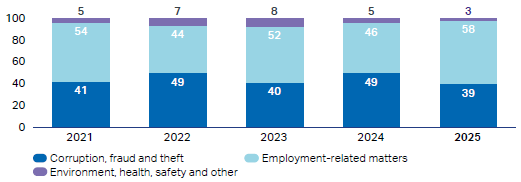
Categories of hotline calls and ethics reports
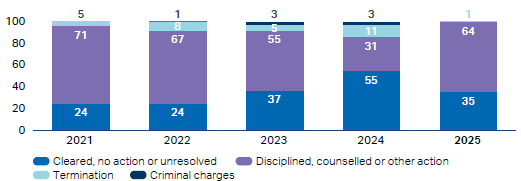
Outcome of the investigations.
There has been an increase in the hotline report rate per
1,000 employees and forensic cases closed in FY2025,
as a result of multiple calls received for the same issues.
This does not imply an increase in risk. Sappi considers
improved utilisation of the hotline as a positive
development. An additional factor is the decrease in
the number of employees at Sappi. The increase in
average days to close forensic cases is primarily related
to employment-related matters.
Sappi's hotline report rates, categories of reports, and
outcomes of cases broadly align with international
whistle-blower benchmark data. For more information,
refer to the Reporting and whistle-blowing section
of the Code of Ethics.
Hotline report rate per 1,000 employees per annum
Forensic cases closed and average time taken to close
Hotline and ethics cases by category (%)
Hotline and ethics case outcomes (%)
Financial statements
The directors are responsible for overseeing the preparation and final approval of the group's Annual Financial Statements, in accordance with International Financial Reporting Standards issued by the International Accounting Standards Board.
The group's results are reviewed prior to submission to the board, as follows:
All quarterly results – by the Disclosure Committee as well as the ARC
The half-year and preliminary annual results are reviewed by external audit. The interim results for Q1 and Q3 are reviewed upon request
The annual financial results are also reviewed by the Disclosure Committee, ARC, and are audited by external audit.
Risk, controls and assurance at Sappi
Risks facing the group are identified, evaluated
and managed by implementing risk mitigations
such as insurance, strategic actions or specific
internal controls. Sappi maintains a robust
framework of risks and controls that assists in
the application of the King IV guidelines and the
achievement of governance outcomes by
helping to create an ethical culture establishing
effective control and promoting legitimacy, all
of which help Sappi and its stakeholders to
benefit from good performance. The framework
includes controls addressing our material
matters by focusing on the main drivers of Sappi
and comprises both financial and non-financial
controls, which support the achievement of our
strategy, within our risk appetite and tolerance
levels, across the economic, social and
environmental context in which the organisation
operates as well as each of the six capitals set
out in the International Integrated Reporting
Council's model. More information on these
capitals and integrated thinking in the context
of Sappi's sustainable business model
can be found in Our strategy and
performance, as well
as Our global sustainability goals.
The group's internal controls and systems are
designed in accordance with the Committee
of Sponsoring Organizations' control framework
to support the achievement of the group's
objectives, including strategic, operational and
financial performance goals, effective and
efficient use of resources, safeguarding assets
against material loss, integrity and reliability
of internal and external financial and non-financial
reporting, and compliance with
applicable laws and regulations.
Sappi operates a combined assurance
framework, which aims to optimise the
assurance coverage obtained from
management and internal and external
assurance providers on the risk areas affecting
the group. Combined assurance is overseen
by CAC. The committee and its CAW provide
holistic feedback to the GRMT and ARC on the
state of controls and the quality and coverage
of assurance from the various assurance
providers across Sappi's three lines
of assurance. The workgroup focused on the
following risk topics in 2025: fibre certification,
fraud and ethics management, cyber security,
operational technology, legal compliance,
business continuity, contractors and
maintenance, energy, waste and safety.
In FY2026, the CAW will assist the CAC
to create and protect value by further
developing combined assurance, risks and
controls relating to IT security, regulatory
compliance and sustainability.
Sappi's combined assurance framework, incorporating three lines of assurance and oversight by the board and board sub-committees:
Risk areas and value drivers, capitals
First line
of assurance
Second line
of assurance
Third line
of assurance
Oversight by
the board
Business management operations supported by appropriate controls and systems
Monitoring and oversight functions
Independent assurance provided by external audit, internal audit and other assurance providers through the audit of certifications
Board and board sub-committees
Governance, risk and controls – general (core business cycles)
Day-to-day risk management activity
Established risk and control environment
Executive, corporate and regional lead teams
Corporate and regional business functions, eg sales, finance, IT, HR, purchasing
Business units, eg forestry, mills, sales offices
Business unit operations, eg production, engineering, controlling, materials management.
CAC, management self-assessments
Internal audit
Audit and Risk sub-committee
Strategy and vision, competition and markets, sociopolitical
Executive Committee, Group Head Strategy, Global Business Council, CAC, management self-assessments
Internal audit
Nomination and Governance Committee
Financial, tax and treasury
Control and assurance, accounting standards, taxation, treasury and Disclosure Committees, management self-assessments
KPMG, tax authorities, internal audit
ARC
Legal and compliance
Legal compliance programme, Group Compliance Manager
Legal compliance audits, internal audit
ARC, SETS Committee, and Human Resources and Compensation Committee
IT
IT Steering Committee, group IT governance functions, management self-assessments
KPMG, ISA 3402s, penetration testing, internal audit
ARC
Planet, environment, natural capital
Sustainability Councils, Global E4 Committee (GEC), GRMT
ISO 14001, FSC™, PEFC, SFI®, EMAS, KPMG, EcoVadis
Government reviews emissions effluent etc, internal audit
SETS Committee
Ethics
Group Compliance Manager, ethics surveys, management self-assessments
Internal audit
SETS Committee, ARC
People, HR and transformation
Global Human Resource Committee, regional labour forums, employee engagement surveys, management self-assessments
BBBEE audits, internal audit
ARC, SETS Committee, and Human Resources and Compensation Committee
R&D, intellectual property
Group technical cluster, management self-assessments
Technical clusters and platforms, regional safety, health, environment and quality audits, supplier audits, management self-assessments
ISO 9001, ISO 50001, FSC™, PEFC, SFI®, matrix, internal audit
SETS Committee
Stakeholders, communication, reputation, society
Group corporate affairs, sustainability and investor relations functions
Internal audit
SETS Committee
Safety
Group and regional risk management teams, safety audits
ISO 45001, ISO 22000, regulatory inspections, internal audit
SETS Committee
A key element of combined assurance at Sappi is derived
from the annual control self-assessments completed
by control owners, which helps to protect value for
stakeholders by providing management and the board with
assurance on the state of controls throughout the group. The
remediation of control gaps identified through this process
is monitored by management, relevant committees, auditors
and the board.
The ARC advises the board on the state of risk management
and controls, as well as assurance, in Sappi's operating
environment. This information is used as the basis for the
board's review, sign-off and reporting to stakeholders, via the
Annual Integrated Report and Annual Financial Statements,
on risk management and the effectiveness of internal
controls and assurance within Sappi.
As part of combined assurance with respect to reported
information, Sappi has obtained assurance on the data
in the Annual Integrated Report from the following sources:
Financial data is independently audited by KPMG
External sustainability assurance was obtained from KPMG
in 2025 for Scope 1 and 2 emissions information, water
usage in South Africa, fibre certification, waste, as well
as specific safety information
Specific planet (environment) related processes are
subject to review by third parties during the year. Certain
local environmental and safety reporting is subject to audit
by local regulators
Reviews of sustainability information were undertaken
by central technical management and internal audit.
Internal audit
The group has an effective, suitably resourced, risk-based
Internal Audit department. The department operates in terms
of a specific charter from the ARC and independently
appraises the adequacy and effectiveness of the group's
governance, risk management, systems, internal controls
and accounting records. Internal audit coordinates combined
assurance and reports the findings to local and divisional
management, the external auditors, and the ARC.
The Head of Internal Audit reports to the ARC, meets
with board members, has direct access to executive
management and is invited to attend certain management
meetings.
The role of the internal audit function at Sappi is set out
in the following diagram:
Internal audit value proposition
During 2025, the risk-based coverage plan was substantially
achieved. Apart from the ongoing focus on financial controls,
internal audit helped to create and protect value for Sappi
and our stakeholders by completing reviews in support
of the following strategic objectives:
Achieve cost advantages: advisory services to the global
business systems projects (requisition to pay, sales order
to cash, implementation of advanced analytics,
procurement, as well as contractor charges)
Rationalising declining businesses: project management
reviews for business optimisation projects
Accelerate growth in higher-margin products: assurance
reviews of sales, R&D, and Somerset Mill conversion
and expansion project in SNA.
In 2026, internal audit will support the achievement of Sappi's
Thrive strategic objectives by completing advisory and
assurance projects in the following areas:
Grow our business: R&D, packaging and speciality papers
Sustain our financial health: sales, procurement, treasury, working capital processes and activities
Drive operational excellence: sales and operations, maintenance, energy, strategic business and IT projects, including global Mill Execution System (MES) projects
Internal audit maintains an internal quality assurance
programme. Our last external quality assurance review was
conducted by the Institute of Internal Auditors (IIA) in 2025.
A Fully Conforms rating was received, which is the highest
of the four levels of conformance to the IIA's standards. The
external review commended internal audit on its credibility,
technical expertise, deep knowledge of the business, and
ability to operate as a cohesive 'OneSappi' global audit team.
Stakeholders consistently highlighted the constructive,
collaborative nature of their interactions with GIA, as well
as the relevance and quality of the assurance provided. The
function is not only trusted as an assurance provider but also
respected as a strategic partner in governance, risk and
control enhancement. Matters that arose and have been
addressed include enhancing root cause analyses and
improving report turnaround.
A focus for 2026 will be further updated to internal audit's
approach to leverage technology (AI and advanced analytics).
Board assessment of the company's risk management, compliance function and effectiveness of internal controls, and
combined assurance
The board is responsible for the group's systems of internal
financial and operational control. As part of an ongoing
comprehensive evaluation process, control self-assessments,
independent reviews by internal audit, external
audit and other assurance providers were undertaken across
the group to test the effectiveness of various elements of the
group's financial, disclosure and other internal controls
as well as procedures and systems. Identified areas
of improvement are being addressed to strengthen the
group's controls further. The board has assessed the
combined assurance provided in 2025. The results of the
reviews did not indicate any material breakdown in the
functioning of these controls, procedures and systems
during the year. The internal controls in place, including the
financial controls and financial control environment, are
considered to be effective and provide a sound basis for the
preparation of the Annual Financial Statements, Annual
Integrated Report, and other reports used internally for
management's decision-making.
Company Secretary
The Company Secretary does not fulfil executive management functions outside of the duties of Company Secretary
and is not a director. During the year, the board has assessed the independence, competence, qualifications and
experience of the Company Secretary and has concluded that she is sufficiently independent (ie maintained an arm's
length relationship with the executive team, the board and individual directors), qualified, competent and experienced
to hold this position. The Company Secretary is responsible for the duties set out in section 88 of the Companies Act 71
of 2008 (as amended) of South Africa. Specific responsibilities include providing guidance to directors on discharging
their duties in the best interests of the group, informing directors of new laws affecting the group, as well as arranging for
the induction of new directors.