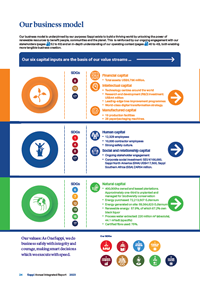
Sappi's business model is underpinned by our purpose: we exist to build a thriving world by unlocking the power of
renewable resources to benefit people, communities and
the planet.
We transform woodfibre from responsibly managed forests into
a broad portfolio of dissolving wood pulp, paper, packaging
papers and innovative biomaterials, delivering sustainable
solutions that meet the needs of a low-carbon, circular economy.
This model is reinforced by ongoing engagement with
our stakeholders and an in-depth
understanding of our operating context,
both of which enable more tangible value creation and informed
decision-making. Anchored in our Thrive strategy, we integrate
Principles, Prosperity, People and Planet (the 4Ps) to ensure that climate action, nature stewardship and social impact are
embedded in how we create, deliver and capture value. Our
integrated operations and global sales network allow us to meet
customer demand for low-carbon, circular and nature-positive
products while driving efficiencies and innovation.
In South Africa, where our plantation forestry operations
play a pivotal role in rural economies, our activities create
significant social value through employment, small-grower
programmes and community partnerships, reinforcing our
commitment to a just transition. By aligning financial
performance with environmental and social responsibility,
Sappi positions itself as a trusted partner in building
a thriving, inclusive and nature-positive future.
Select to view
- InputsOur six capital inputs are the basis of our value streams ...
- Value streamsLeveraging these value streams ...
- Strategyenables the realisation of our Thrive strategy ...
- Outputsand generates certain outputs ...
- OutcomesOur business activities create, preserve and erode value, leading to certain key outcomes ...
- Actions which we work to enhance in the following ways:
- Our trade-offsThese are detailed throughout this report, with the key trade-offs detailed alongside.

Monitoring and reporting on our ambitious SDG-related 2025 goals aligns with our Thrive strategy
of being a trusted partner to all our stakeholders. See our 2025 Sappi Group Sustainability Report
for more information.

Prosperity
Capitals

Financial

Intellectual

Social and relationship

Manufactured
- Adjusted EBITDA1: US$501 million
- Net debt: US$1,920 million
- US$992 million paid to employees as salaries, wages and other benefits
- US$264 million reinvested to grow the business
- US$71 million paid to governments as taxation
- US$104 million paid to lenders of capital as interest
- US$85 million paid to shareholders as dividends
- 17 new products with sustainability benefits launched over last five years to meet evolving market demands.
1 EBITDA excludes special items and plantation fair value price adjustment.
- Digital transformation strategy is progressing well
- Modernisation of PM11 at Gratkorn Mill completed and will allow us to continue to serve the print market profitably
- Investment at Gratkorn Mill to convert PM9 to produce high-quality label expands the production capabilities of the machine so that it can produce a full range of
high-quality label papers including self-adhesive and wet strength labels in addition to traditional coated woodfree graphic papers. Sales volumes growing according to plan
- Investment at Somerset Mill to convert PM2 to solid bleached sulphate (SBS) paperboard completed in May 2025 and ramp-up is in progress
- Decarbonisation investments at Kirkniemi, Gratkorn, Maastricht and Saiccor Mills delivering not only significant CO2 savings but also variable cost savings.
Debt reduction remains our top capital allocation
priority over the next two years. To balance the
trade-off between capital-intensive carbon
abatement initiatives and sustaining our financial
health, we will focus in the short-term on
operational efficiency improvements and
Scope 2 emission reductions in South Africa
through a renewable power purchase agreement,
while phasing larger investments responsibly.
Risks
- Risk 5: Evolving technologies and consumer preferences
- Risk 10: Liquidity.

People
Capitals

Human

Social and
relationship
- The 2025 Employee Engagement Survey showed an increased participation rate and an increase in the percentage of engaged employees compared to 2023 survey
- One employee and one contractor fatality
- Improvement in the group LTIFR
- Global training average (weighted) of 59.95 hours per employee (FY2024: 46.7 hours)
- Productivity 4.8 hours worked per ton of saleable production (FY2024: 4.4 hours)
- Maintained our Level 1 BBBEE contributor status.

- Central action tracker facilitates the resolution of issues identified in the Employee Engagement Survey
- Global safety performance unsatisfactory with LTIFR of SNA and SEU deteriorating compared to last year and two fatalities in SSA
- Global target to increase proportion of women in management: All three regions achieved 2025 target
- Code of Ethics training to all employees in line with our strong governance culture.
In response to market overcapacity and in line
with our strategy of reducing exposure to graphic
papers markets, in 2025 we initiated consultation
processes at Kirkniemi and Alfeld Mills to close
three paper machines and reduce shifts
at Ehingen Mill from five to three. Consultations
were completed shortly after financial year-end.
Risks
- Risk 10: Employee relations.

Planet
Capitals

Natural
- Decrease in specific GHG Scope 1 and 2 emissions
- Slight increase in global specific energy usage
- Specific process water usage in SSA not achieved
- At stand level, our plantations have a negative impact on biodiversity. At plantation level, we manage this impact by managing approximately one-third of our landholdings for biodiversity
- Achieved a 25.3% biodiversity improvement within our South African forestry conservation area landholdings
- Lighter-weight packaging products – lighter carbon footprint
- 78% certified fibre supplied to mills enhances our competitive advantage.

- Sappi Chair in Climate Change and Plantation Sustainability
at the University of the Witwatersrand will provide more
accurate climate models and replicable, workable
methodologies which will benefit Sappi and the industry
- Collaborating with World Business Council for
Sustainable Development (WBCSD) Forest Solutions
Group (FSG) to identify appropriate climate, nature and equity actions and develop appropriate metrics for our sector
- Our World Wide Fund for Nature (WWF) Water
Stewardship project in the uMkhomazi catchment near
Saiccor Mill advancing water security for the region
- Sappi Rare, Threatened and Endangered Species
Stewardship Programme continues to deliver value. Due
to Sappi’s efforts Warburgia salutaris, commonly known
as the Pepper-bark tree, was reclassified in 2025 from
endangered to vulnerable.
Market-driven production curtailments continued
to impede our operational efficiency, causing us to
fall short of some of our intensity-based planetrelated
targets for the year. For example, energy
intensity and Scope 1 (direct) and Scope 2
(indirect) GHG emissions intensity did not reach
our targets.
Risks
- Risk 4: Sustainability expectations
- Risk 6: Climate change.
 |
Forests
- Our FSCTM (FSCTM N003159) and PEFC (PEFC/01-44-43)
certified tree plantations in South Africa provide a high-quality
woodfibre base and enhance our competitive
advantage. Our leading-edge tree improvement
programmes ensure this advantage is maintained
and leveraged.
|
|
 |
Manufacturing excellence
- We focus on enhancing machine efficiencies, digitising our
processes to make the smart factory a reality, reducing
variable costs through new logistics and procurement
practices and implementing go-to-market strategies which
lower the cost of serving our customers and increase
customer satisfaction.
|
 |
Biomaterials
- We are unlocking the chemistry of trees and aligning with
the circular economy by establishing a strong position in
adjacent businesses, including fibrillated cellulose,
lignosulphonates and bioenergy. Extracting more value
from each tree is at the core of our business model.
|
|
 |
Pulp
- Our dissolving wood pulp (DWP) brand, Verve, creates
renewable alternatives for raw material feedstock to textiles,
pharmaceuticals, foodstuffs and more – products that meet
the needs of people around the globe every day.
|
 |
Speciality papers
- Our customers use our speciality papers to add value to
niche markets and enable product differentiation. Our focus
on innovation helps our customers to meet and anticipate
the challenges of changing market dynamics.
|
|
 |
Packaging papers
- Our packaging solutions offer environmentally conscious
consumers an alternative to fossil-fuel-based packaging
papers.
|
 |
Graphic papers
- Our market-leading range of coated and uncoated graphic
papers products is used in magazines, corporate reports
and accounts, direct mail, high-quality brochures,
catalogues, calendars and books.
|
|
|
|

Grow our business

Sustain our financial health

Drive operational excellence

Enhance trust
Products:
- 5,141,043 tons of saleable production.
Waste:
- 1,782,388 tons of waste
generated, of which
1,471,627 tons (82.6%) diverted
from disposal.
Emissions:
- 3.2 million t CO2e absolute direct
(Scope 1) GHG, in specific terms:
0.62 t CO2e/adt.
Our values: As OneSappi, we do
business safely with integrity and
courage, making smart decisions
which we execute with speed.